Categorie archief: schilderkunst

Italiëgangers [ 3 ]

Thomas Cole (1801-1848) en de Hudson River School

De reis naar Italië was in de negentiende eeuw niet alleen voor veel Europese schilders een (bijna) verplicht nummer, ook in de Verenigde Staten maakten veel schilders de reis naar het oude Europa. Een van hen was de van origine Engelse Thomas Cole die tussen 1829 en 1831 o.a. in Italië verbleef. Bij zijn terugkeer in de Verenigde Staten zou hij aan het begin staan van de zgn. Hudson River School. De schilders van deze school keerden bewust Italië en het oude Europa de rug toe en verheerlijkten de imponerende Amerikaanse wildernis met schilderijen in even imponerende formaten.
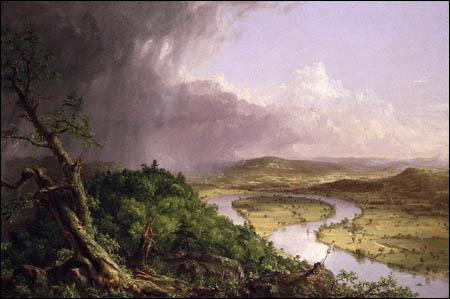
The Oxbow
Thomas Cole
The Oxbow, 1836

Voor de identiteit van de jonge Verenigde Staten hadden deze majestueuze natuurtaferelen bijzondere betekenis. Zo wilde men graag geloven dat de ongerepte natuur die men aan de overzijde van de oceaan aantrof, zonder sporen van beschaving, laat staan van verwoestende industrialisering, een aards Paradijs was dat de Schepper persoonlijk aan de Amerikanen geschonken had. Het was voor de jonge Verenigde Staten de compensatie van het gebrek aan verleden en cultuur. God had de Amerikanen bevoorrecht door hen te laten delen in de ongereptheid van Zijn Schepping.

“The new world has something better than ruins and history,” it has natural beauty through which “God had writ the immensity of his plan right here in America.”

Arthur Danto

Thomas ColeThomas Cole was born in 1801 at Bolton, Lancashire in Northwestern England and emigrated with his family to the United States in 1818. During the early years Cole lived for short periods in Philadelphia, Ohio, and Pittsburgh where he worked as an itinerant portrait artist. Although primarily self-taught, Cole worked with members of the Philadelphia Academy, and his canvases were included in the Academy’s exhibitions. In 1825, Cole discovered the haunting beauty of the Catskill wilderness. His exhibition of small paintings of Catskill landscapes came to the attention of prominent figures on the New York City art scene including Asher B. Durand, who became a life-long friend, and his fame spread. While he was still in his twenties, Cole was made a fellow of the National Academy.

In 1829-1831, Cole returned to Britain for study and to attend to family business and to travel to France and Italy. These years were among the most happy and productive of his life. Cole met a large number of wealthy Americans traveling abroad and received numerous commissions from them, increasing his reputation and stature. Cole returned to New York City in November of 1832 and mounted an exhibition of his European paintings, which aroused considerable public interest. Shortly thereafter, Cole first established his rural studio in Catskill, New York, when he rented a small outbuilding at Cedar Grove.
( Bron: thomascole.org )

“The great cultural project of the 19th century was to explore the relations between man and nature, to learn to see nature as the fingerprint of God’s creation . . . No previous age had brought such passionate scrutiny to nature, from the highest Alp to the smallest pollen of grain . . .”

Robert Hughes

Niagara Falls
Frederick Edwin Church, Niagara Falls 1857

Na Cole’s vroegtijdige dood in 1848 had hij nog geen opvolger als leider van de Hudson River School gevonden. Maar in 1857 maakte Frederick Edwin Church (1826-1900) in Amerika én Europa verpletterende indruk met zijn panorama van de Niagara Falls en bracht hij de Hudson River School tot een nieuw hoogtepunt.

Robert Hughes: Well, the idea that you redeem yourself from the sins of Europe; that you can leave the past behind, while at the same time bringing elements of culture, its cultural baggage with you, is very important to Americans. I mean, the Puritans thought that they could do it by, you know, by means of the religious revolution. Then when it became apparent that the–there was this immense field outside of the coastal settlement into which Americans, into which new Americans could move, which they could conquer, dominate, appropriate, and displace the original inhabitants of, there was this almost religious search for the image of landscape, you know, for the discovery of the image of God in the landscape, and, as it were, the appropriation of divine will into human will.
fragment uit American Visions (1997)
van Robert Hughes, episode 3:
The Wilderness and the West
This echoes through and through the paintings of the 19th century, and, you know, you might say that landscape painting is the great religious art form of America. And it became so really as early as the 1820′s with Thomas Cole. The reason why the wilderness has always played such a vast part in the American imagination is not just because it was there. It’s because the constructions that European Americans made of it.
 
Bron: youtube.com

Hudson River School
Asher B. Durand (1796-1886)
Thomas Cole (1801-1848)
John F. Kensett (1816-1872)
Martin Johnson Heade (1819-1904)
George Inness (1825-1894)
Frederick Church (1826-1900)
Albert Bierstadt (1830-1902)
thomascole.org | Hudson River School [ artchive.com]

John Everett Millais [ 2 ]

nagenieten van de tentoonstelling John Everett Millais
in het Van Gogh Museum Amsterdam nog tot 18 mei 2008

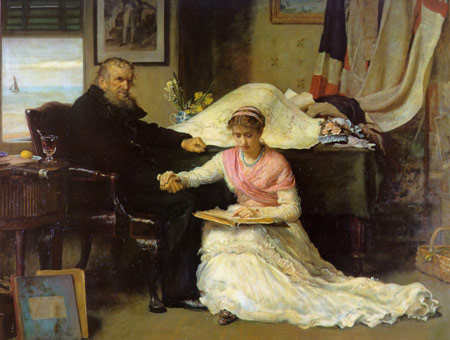
In 1874 is de stijl van Millais helemaal veranderd. Zijn penseelstreek heeft zich verbreed en de kleuren zijn gedempter geworden. Het realisme wordt in Europa steeds meer geaccepteerd en in Frankrijk zijn de impressionisten al aan het doorbreken. Het onderstaande schilderij dat ook op de tentoonstelling in het Van Gogh Museum hangt, is eigenlijk een patriotisch schilderij. De North-West Passage duidt op de noordelijke (arctische) doorvaart naar de West Coast en het Verre Oosten. Een prestatie waarmee Brittania weer eens had bewezen dat het de golven van de wereldzeeën beheerste.

North West Passage
The north-west passage, 1874
It might be done,
and England should do it„

The north-west passage was the sea route round the north of the American continent which was thought to provide a passage to China and the East. Several arctic expeditions had tried and failed to find it. Millais painted this picture in 1874 just when another English expedition was preparing to set off on the same voyage.When the picture was shown at the Royal Academy in 1874 it was accompanied by the lines „It might be done, and England should do it„. This patriotic message is underlined by the presence of the Union Flag draped over a screen.
(Bron: tate.org.uk)

North West Passage
The north-west passage (details)

Millais [ victorianweb.org ]

John Everett Millais [ 1 ]

nagenieten van de tentoonstelling John Everett Millais
in het Van Gogh Museum, Amsterdam, nog tot 18 mei 2008

Een van de mooiste tentoonstellingen die ik de afgelopen jaren zag, is de grote overzichtstentoonstelling van John Everett Millais. Deze is nog tot 18 mei 2008 in het Van Gogh Museum te zien. In de jaren zestig, zeventig en tachtig zou een dergelijke tentoonstelling voor een groot publiek ondenkbaar geweest zijn. Alles wat aan de Victoriaanse tijd herinnerde was in naam van de seksuele revolutie in de ban gedaan. Kitsch, was het eenvoudige maar vernietigende oordeel en daarmee was alles gezegd. Het tij is inmiddels gekeerd. Twaalf jaar geleden bracht hetzelfde Van Gogh Museum een grote overzichtstentoonstelling van het werk van onze eigen Victoriaanse salonschilder Laurens Alma Tadema, toen nog in de donkere gangen op de bovenste verdieping. De overzichtstentoonstelling van Millais is gelukkig in de ruime nieuwe vleugel ondergebracht. Ondanks de royale opstelling verdrongen op zondagmiddag de bezoekers zich voor de schilderijen en dat van Ophelia in het bijzonder.

Isabelle
Isabella, 1849

The painting Isabella is structured with deliberately distorted perspective, elongating the right hand side of the table and flattening the figures ranged along it. Following Pre-Raphaelite theory, Millais almost eliminates chiaroscuro and exaggerates the intensity of juxtaposed colours and tones – as evidenced in the flat black tunic set against the sharply modelled white cloth of the servant at the right, whose lower body virtually disappears as his yellow stockings semi-merge with the background.
(Bron: wikipedia)

Het was mijn eerste kennismaking met het werk van Millais buiten de reproducties om. Gelukkig heeft men gekozen voor een chronologische opstelling, zodat we de stijlontwikkeling kunnen volgen. Naast schilderijen worden ook tekeningen getoond. In zijn begintijd, rond 1850, zien we uiterst gedetailleerde schilderijen. Met een inventariserende blik heeft hij elk detail geschilderd. Daarin gaat hij bewust terug op de Vlaamse Primitieven, die zo natuurgetrouw schilderden dat we nog steeds de afgebeelde planten kunnen determineren.

Isabelle detail
Isabella, detail

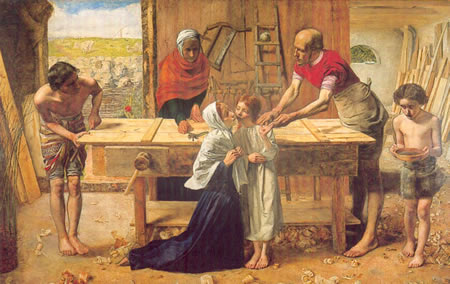
Het overzicht is zeer representatief al ontbreken er enkele topstukken, zoals het hier afgebeelde Isabella. Met dit schilderij kreeg hij in 1849 gunstige kritiek op de tentoonstelling van de Royal Academy. Maar het jaar daarop werd hij zwaar bekritiseerd met een schilderij van de jonge Jezus in de werkplaats van zijn vader Jozef. Dit schilderij hangt gelukkig wel op de tentoonstelling in het Van Gogh Museum.

Isabelle detailIsabella
The painting illustrates an episode from John Keats’s poem, Isabella, or the Pot of Basil, which describes the relationship between Isabella, the sister of wealthy medieval merchants, and Lorenzo, an employee of Isabella’s brothers. It depicts the moment at which Isabella’s brothers realise that there is a romance between the two young people, and plot to murder Lorenzo so they can marry Isabella to a wealthy nobleman. Isabella, wearing grey at the right, is being handed a blood orange on a plate by the doomed Lorenzo. A cut blood orange is symbolic of the neck of someone who has just been decapitated, which is a sign of how Lorenzo will be killed by Isabella’s brothers. One of her brothers violently kicks a frightened dog while cracking a nut.
 
Bron: wikipedia
Jesus in the house of his parents
Dit schilderij hangt gelukkig wel in Amsterdam. In 1850 op de tentoonstelling van de Royal Acadamy had men er geen goed woord voor over.

John Everett Millais in het Van Gogh Museum