Categorie archief: schilderkunst

schilders van de ziel

Schilders van de Ziel Symbolisme in Frankrijk
Singer Museum Laren, nog tot 29 januari 2008

Het Singer Museum in Laren richt zich al sinds 1956 met tentoonstellingen op Nederlandse en Europese kunst(stromingen) uit de periode 1880-1950. Meestal worden daarbij ook werken uit de eigen collectie getoond. De tentoonstelling Schilders van de Ziel Symbolisme in Frankrijk draait alweer drie maanden en is nog twaalf dagen te zien.
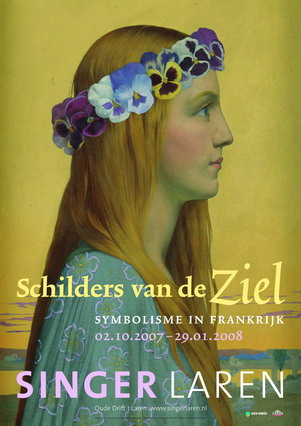
Schilders van de ziel
Het symbolisme is een geesteshouding die reageerde op het heersende positivisme en de teloorgang van spiritualiteit, als gevolg van de industriële revolutie en het geloof in de wetenschap. Kenmerkend is het willen uitdrukken van zielstoestanden en ideeën, met symbolen zoals dromen, visioenen en sprookjes, waarbij de suggestie en emotie een belangrijke rol spelen. Geliefde onderwerpen zijn de vlucht en het ontstijgen aan de materiële wereld. Grote belangstelling is er voor het spirituele, religies (katholicisme), esoterie, satanisme en klassieke mythen en oude legenden.
 
Bron: singerlaren.nl

singerlaren.nl | symbolisme [ nl.wikipedia.org ] | symbolisme[ artcyclopedia.com ]
Symbolism [ metmuseum.org ]
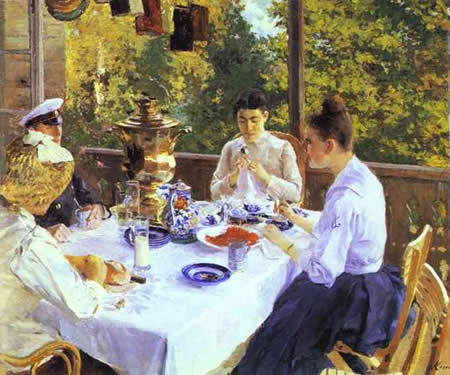
Russische schilders [ 8 ]

Konstantin Korovin ( 1861-1939)
At a Tea Table
At a Tea Table, 1888
Verwissel de samovar met een paar flessen wijn en een mand baguettes en je denkt dat het een schilderij van Renoir is.
KorovinIn 1875 Konstantin Korovin entered the Moscow School of Painting, Sculpturing and Architecture, where he learned from Vasily Perov and Alexei Savrasov. His brother, Sergey was already a student of the School. During their scholar years Korovins became friends with their fellow students Valentin Serov and Isaac Levitan, Kontantin kept these friendship through the whole of his life.
 
In 1881-1882, Korovin spent a year at the Imperial Academy of Arts in Saint Petersburg, but returned disappointed to the Moscow School of painting, sculpturing and architecture. He studied at the school under the new teacher Vasily Polenov until 1886. In 1885, Korovin made traveled to Paris and Spain. Paris was a shock for me Impressionists in them I found everything for what I was scolded back at home, in Moscow, he later wrote. Korovin.Polenov introduced Korovin to Savva Mamontov’s Abramtsevo circle: Viktor Vasnetsov, Apollinary Vasnetsov, Ilya Repin, Mark Antokolsky and others. The Abramtsevo circle’s love for stilized Russian themes is reflected in Korovin’s picture A Northern Idyll. In 1885 Korovin works for Mamontov’s Opera house. He designed the stage decor for Giuseppe Verdi’s Aida, Léo Delibes’ Lakme and Georges Bizet’s Carmen.
St. Triphon's Brook in Pechenga
St. Triphon’s Brook in Pechenga, 1894
He was painting in the Impressionist and later in the Art Nouveau style. In the 1890s, Korovin became a member of the Mir iskusstva art group. Korovin’s subsequent works was strongly influenced by his travel to the North. In 1888 he was captivated by the stern northern landscapes, as seen in The Coast of Norway and The Northern Sea. His second trip to the North, with Valentin Serov in 1894, coincided with the construction of the Northern Railway. Korovin painted a large number of landscapes: Norwegian Port, Saint Trifon’s Brook in Pechenega, Hammerfest: Aurora Borealis, The Coast at Murmansk and others. The paintings are built on a delicate web of shades of grey. The etude style of these works was typical for the Korovin’s art of the 1890s. Using material from his northern trip, Korovin designed the Northern Railway pavilion at the All Russia Exhibition of 1896 at Nizhny Novgorod. In 1900, Korovin designed the Central Asia section of the Russian Empire pavilion on the Paris World Fair; and was awarded the Legion of Honour by the French government.
 
Bron: en.wikipedia.org

Konstantin Korovin [ Olga's Gallery ] | meer Russische schilders

Russische sprookjes

Russische sprookjes, volksverhalen en legenden
in het Groninger Museum , 15 december 2007 tot 6 april 2008

Russische sprookjesIn oktober schreef ik hier iets over de Amsterdamse kunstenares Maryleen Schiltkamp die op dit moment werkt in Sint Petersburg. In haar nieuwste werk laat ze zich inspireren door de Russische cultuur, in het bijzonder de Russische sprookjes en volksverhalen. Zij is niet de eerste. Zo kennen we in het Westen inmiddels allemaal de vuurvogel, bekend geworden door Igor Stravinsky. Minder bekend is de naam van Ivan Bilibin die veel heeft bijgedragen tot de verspreiding van de Russische sprookjes in het Westen. Hij werkte als decor- en kostuumontwerper voor Serge Dhiagilev en zijn Les Ballet Russes, dat in Europa en zeker in Frankrijk wéll klinkende namen zijn geworden. Illustraties van Bilibin zijn nu te zien in het Groninger Museum. Door een gelukkige verstandhouding tussen de Nederlandse Gasunie en het Russische Gazprom heeft dit museum het voorrecht om elke paar jaar een prestigieuze tentoonstelling met Russische kunst te organiseren. Repin (2001/2002), Het Russische Landschap (2003/2004) en In Dienst van Diaghilev (2004) gingen de huidige tentoonstelling over Russische sprookjes, volksverhalen en legenden voor.
Hoewel sprookjes al honderden jaren in de folkloretraditie voorkwamen, werden ze pas in de negentiende eeuw een volwaardig thema binnen de schilderkunst. De aandacht voor Russische legenden en sprookjes bloeide in deze periode op en kwam voort uit een verlangen om terug te grijpen op de traditie die uiting gaf aan het echte Rusland. Deze zoektocht naar de oorspronkelijke Russische traditie was uniek en leidde tot een eigen stijl in de Russische schilderkunst waarvan Victor Vasnetsov een van de belangrijkste vertegenwoordigers werd.
 
Bron: groningermuseum.nl

Groninger Museum