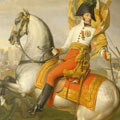
kopie van Dmitry Golitsyn (ca. 1825) door George Dawe
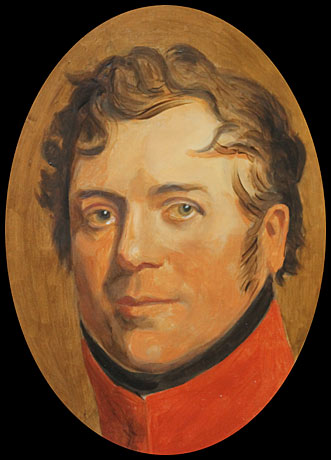
na de tweede sessie in olieverf.
volg de meester [ 1-104 ] | van oude meesters en dingen die niet voorbijgaan
volg de meester [ 1-104 ] | van oude meesters en dingen die niet voorbijgaan
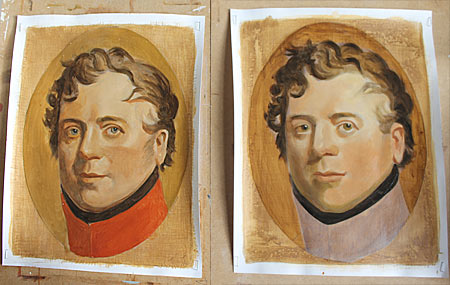
Bij het kopiëren van het portret van Dmitry Golitsyn (ca. 1825) door de Engelse portretschilder George Dawe gebruikte ik meer Engels rood dan normaal. Dit dekkende ijzeroxide heeft een enorme kleurkracht en gebruik ik meestal spaarzaam vermengd met gele oker voor de wangen en lippen. Maar het boord van de Russische cavalerie generaal Dmitry Golitsyn schilderde ik met onversneden Engels rood. Een glacis van dunne rauwe omber en een enkele accenten in gele oker zullen in een volgende fase het effen boord reliëf geven.
volg de meester [ 1-103 ] | van oude meesters en dingen die niet voorbijgaan
De tentoonstelling over Elisabeth Vigée Le Brun ( 1755-1842) die afgelopen najaar in het Grand Palais in Parijs te zien was, zal vanaf 15 februari drie maanden lang te zien zijn in het Metropolitan Museum of Art in New York. Daarna reist deze tentoonstelling door naar Ottawa. In oktober schreef ik iets over de documentaire Le fabuleux destin d’Elisabeth Vigée Le Brun die naar aanleiding van deze tentoonstelling over haar leven gemaakt is.
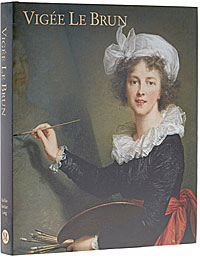 Elisabeth Louise Vigée Le Brun (1755–1842) is one of the finest eighteenth-century French painters and among the most important of all women artists. An autodidact with exceptional skills as a portraitist, she achieved success in France and Europe during one of the most eventful, turbulent periods in European history.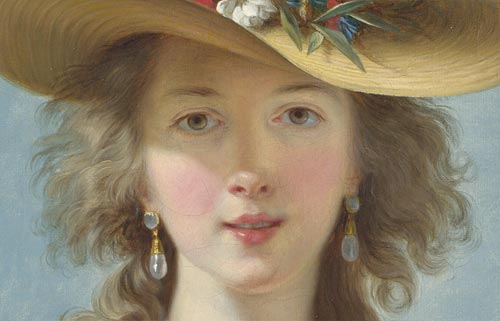
Le fabuleux destin d’Elisabeth Vigée Le Brun [ boutique.arte.tv ]
 In de voetsporen van Heidegger
 Voetnoten bij de 19e eeuw
 Amerikaanse Burgeroorlog
 Napoleon en zijn schilders
 Landschapsschilders uit de Goethezeit
 Schilders in Italië
 De schilder en zijn broodheer
 De waakzaamheid van het hart
 Ovidius’ Metamorphosen
 Dantes Divina Commedia
 Wolkenkrabbers
 Op zoek naar de atoomstijl
 Een avontuur van luitenant Blueberry
 My favourite things