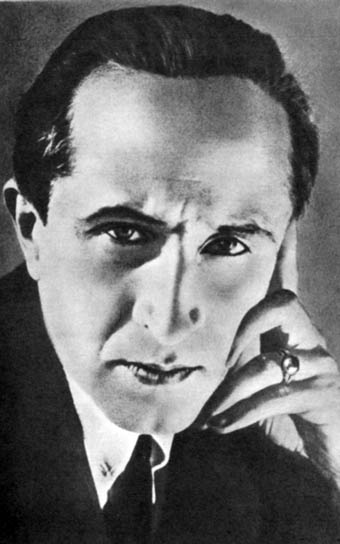
Een andere bekende Russische cineast uit de twintiger jaren is Lev Kuleshov. Zijn naam is net zoals met die andere Rus (Pavlov) verbonden aan een bepaald experiment. Kuleshov ontdekte dat de context van een beeld allesbepalend is voor de interpretatie van dat ene beeld. Hij filmde eerst het gezicht van een neutraal kijkende man en combineerde dat daarna drie keer met een ander beeld. De eerste keer een bord soep, de tweede keer een spelend meisje en de derde keer een kist met een kind erin. Het publiek was enthousiast over het talent van de acteur. Hoe subtiel speelde hij eerst honger, daarna vaderlijk plezier en tenslotte verdriet. Kuleshov had met dit experiment bewezen dat de betekenis van een beeld afhangt van wat ervoor of erna gemonteerd wordt. Dit is sinds 1918 de geschiedenis ingegaan als het Kuleshov effect
 Kuleshov edited a short film in which shots of the face of Ivan Mozzhukhin (a Tsarist matinee idol) are alternated with various other shots (a plate of soup, a girl, a child’s coffin). The film was shown to an audience who believed that the expression on Mozzhukhin’s face was different each time he appeared, depending on whether he was `looking at’ the plate of soup, the girl, or the child’s coffin, showing an expression of hunger, desire or grief respectively. Actually the footage of Mozzhukhin was identical, and rather expressionless, every time it appeared. Vsevolod Pudovkin (who later claimed to have been the co-creator of the experiment) described in 1929 how the audience “raved about the acting…. the heavy pensiveness of his mood over the forgotten soup, were touched and moved by the deep sorrow with which he looked on the dead woman, and admired the light, happy smile with which he surveyed the girl at play. But we knew that in all three cases the face was exactly the same.”
Bron: Kuleshov effect
 Once ranked alongside Eisenstein among the masters of the Soviet silent cinema, Pudovkin’s critical stock has fallen in recent years, and few of his films are now well known. Nevertheless, the invention and dynamism of Mother (1926) suggest a distinct talent, with a grasp of montage principles which does at times rival Eisenstein. Given the obscurity of most of his later films (including a lengthy career in sound cinema), revaluation might well uncover some forgotten gems. In the silent era, Pudovkin also acted; an especially striking performance is visible in Kuleshov’s The Extraordinary Adventures Of Mr West In The Land Of The Bolsheviks (1924).
_WEB.jpg) Pudovkin’s first feature length fiction film, an adaptation of a story by Gorky about a peasant mother who comes to embrace revolutionary ideals, is regularly cited as a classic of Soviet silent cinema for its imaginative montage. Certainly the editing is superbly judged, but Pudovkin’s visual sense is here above all architectural, and at its best reminiscent of Fritz Lang. The oppression of the workers is visualised both in the confined interiors of their homes and in the towering pinnacles of factory and prison, while the finest montage sequences intensify the visual claustrophobia, until it is exploded in the famous climax: marching rebels cross-cut with the breaking up of an ice floe. Gripping and moving.
Pudovkin’s first feature length fiction film, an adaptation of a story by Gorky about a peasant mother who comes to embrace revolutionary ideals, is regularly cited as a classic of Soviet silent cinema for its imaginative montage. Certainly the editing is superbly judged, but Pudovkin’s visual sense is here above all architectural, and at its best reminiscent of Fritz Lang. The oppression of the workers is visualised both in the confined interiors of their homes and in the towering pinnacles of factory and prison, while the finest montage sequences intensify the visual claustrophobia, until it is exploded in the famous climax: marching rebels cross-cut with the breaking up of an ice floe. Gripping and moving.