Categorie archief: Italië

virtuele reis door de hel [5]

deze maand daal ik met Dante en Vergilius af in de hel
de vierde kring: de hebzuchtigen

In de vierde kring duwen de hebzuchtigen én de verkwisters zware lasten zinloos heen en weer.
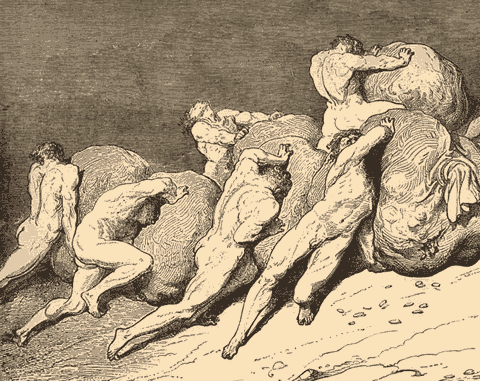
hebzuchtigen
Avarice–greed, lust for material gain–is one of the iniquities that most incurs Dante’s scornful wrath. Consistent with the biblical saying that avarice is “the root of all evils” (1 Timothy 6:10), medieval Christian thought viewed the sin as most offensive to the spirit of love; Dante goes even further in blaming avarice for ethical and political corruption in his society. Ciacco identifies avarice–along with pride and envy–as one of the primary vices enflaming Florentine hearts (Inf. 6.74-5), and the poet consistently condemns greed and its effects throughout the Divine Comedy. Dante accordingly shows no mercy–unlike his attitude toward Francesca (lust) and Ciacco (gluttony)–in his selection of avarice as the capital sin punished in the fourth circle of hell (Inferno 7). He viciously presents the sin as a common vice of monks and church leaders (including cardinals and popes), and he further degrades the sinners by making them so physically squalid that they are unrecognizable to the travelers (Inf. 7.49-54). By defining the sin as “spending without measure” (7.42), Dante for the first time applies the classical principle of moderation (or the “golden mean”) to criticize excessive desire for a neutral object in both one direction (“closed fists”: avarice) and the other (spending too freely: prodigality). Fittingly, these two groups punish and insult one another in the afterlife.
 
Bron: danteworlds.laits.utexas.edu

Dante Online | illustraties Doré | Dante’s Inferno

virtuele reis door de hel [4]

deze maand daal ik met Dante en Vergilius af in de hel
de derde kring: de vraatzuchtigen

In de derde kring, waar het eeuwig regent, bevinden zich de vraatzuchtigen, die bewaakt en gemarteld worden door de hellehond Cerberus.

de vraatzuchtigen
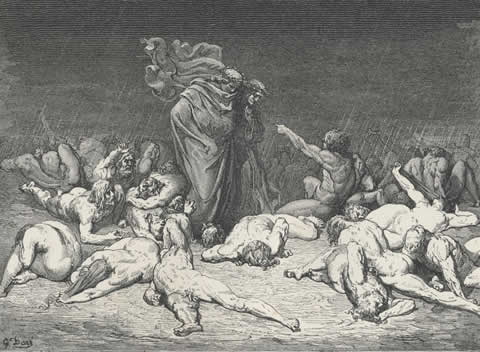
om mijn verdoemelijke vraatzuchtigheid werd ik door deze regen neergeslagen
Gluttony–like lust–is one of the seven capital sins (sometimes called “mortal” or “deadly” sins) according to medieval Christian theology and church practice. Dante, at least in circles 2-5 of hell, uses these sins as part–but only part–of his organizational strategy. While lust and gluttony were generally considered the least serious of the seven sins (and pride almost always the worst), the order of these two was not consistent: some writers thought lust was worse than gluttony and others thought gluttony worse than lust. The two were often viewed as closely related to one another, based on the biblical precedent of Eve “eating” the forbidden fruit and then successfully “tempting” Adam to do so (Genesis 3:6). Based on the less than obvious contrapasso of the gluttons and the content (mostly political) of Inferno 6, Dante appears to view gluttony as more complex than the usual understanding of the sin as excessive eating and drinking.
 
Bron: danteworlds.laits.utexas.edu

Dante Online | illustraties Doré | Dante’s Inferno

virtuele reis door de hel [3]

deze maand daal ik met Dante en Vergilius af in de hel
de tweede kring: de wellustigen

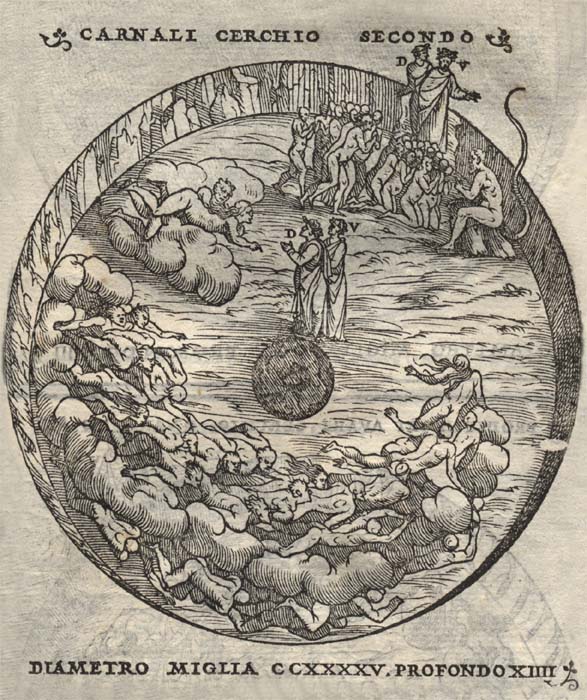
In deze kring woedt een eeuwige storm, die de zielen voortblaast van de wellustigen, die hun erotische verlangens niet konden beheersen; o.a. Francesca da Rimini, Cleopatra VII en koningin Dido van Carthago. Blijkbaar had Dante vooral vrouwen op het oog…

wellustigen
de wellustigen
Here Dante explores the relationship–as notoriously challenging in his time and place as in ours–between love and lust, between the ennobling power of attraction toward the beauty of a whole person and the destructive force of possessive sexual desire. The lustful in hell, whose actions often led them and their lovers to death, are “carnal sinners who subordinate reason to desire” (Inf. 5.38-9). From the examples presented, it appears that for Dante the line separating lust from love is crossed when one acts on this misguided desire. Dante, more convincingly than most moralists and theologians, shows that this line is a very fine one indeed, and he acknowledges the potential complicity (his own included) of those who promulgate ideas and images of romantic love through their creative work. Dante’s location of lust –one of the seven capital sins–in the first circle of hell in which an unrepented sin is punished (the second circle overall) is similarly ambiguous: on the one hand, lust’s foremost location–farthest from Satan–marks it as the least serious sin in hell (and in life); on the other hand, Dante’s choice of lust as the first sin presented recalls the common–if crude–association of sex with original sin, that is, with the fall of humankind (Adam and Eve) in the garden of Eden.
 
Bron: danteworlds.laits.utexas.edu

Dante Online | illustraties Doré | Dante’s Inferno