Chris Leavens

is een illustrator uit de Verenigde Staten
Chris Leavens
Chris Leavens Overgrown
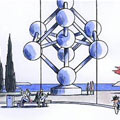
Chris Leavens was born and raised in Pennsylvania. He breezed through school and passed a good deal of time doodling, drawing robots, spaceships, and bizarre creatures. As long as the letter “A” kept showing up on his papers, Chris’s teachers didn’t really seem to care. He continued both his education and his doodling at Penn State University, where he graduated with a BA in film and video. A few months after graduating, Chris migrated west to Los Angeles in search of work in the film industry. Many adventures followed, including a brief career as a video editor and motion graphics designer, as well as his directorial debut, I Don’t Know Jack, a feature documentary about Jack Nance, star of David Lynch’s Eraserhead. Chris decided to take a break from the film biz and began working as an illustrator, graphic designer, and web designer, focusing primarily on educational material for children. This “break” has more than outlived Chris’s Hollywood career and continues to this day. Currently, Chris is focusing on creating vector art using Adobe Illustrator CS3. He produces most of his artwork — from start to finish — entirely in Illustrator, including textural elements. His work incorporates absurdity, anthropomorphism, and a healthy dose of humor.
 
Bron: imagekind.com

unloosen.com

another glass box ?

Lever House (1952) en Seagram Building (1958)
de doorbraak van de International Style in de jaren vijftig

De bouwprincipes van De Stijl en het Bauhaus culmineerden halverwege de vorige eeuw in wat we de International Style zijn gaan noemen. De helderheid, doelmatigheid en eenvoud die de architecten van het funktionele bouwen voorstonden, maakten eindeloze herhaling en inwisselbaarheid mogelijk. Het paradigma “minder is meer” ontaardde al snel van “minder is goedkoper” in “minder is saai”. Na de Tweede Wereldoorlog veranderde de moderne stad in razendsnel tempo in een pakhuis vol monotone blokken.

Lever House
Lever House (1952)
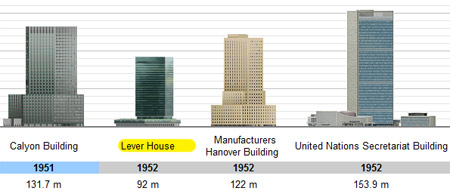
Samen met het United Nations Secretariat Building dat in hetzelfde jaar gereed kwam, introduceerde Lever House de ‘vliesgevel’

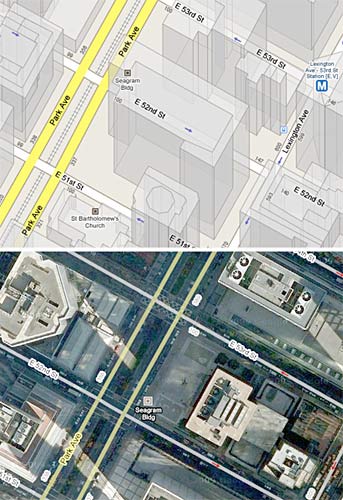
Op Park Avenue ter hoogte van de 52e en 53e straat liggen twee beroemde prototypen van deze zgn. ‘glass boxes’ schuin tegenover elkaar: Lever House (1952) en Seagram Building (1958) De verzuchting “Another glass box” is volgens de experts misplaatst. De beide gebouwen nemen in de kanon van twintigste eeuwse architectuur een vooraanstaande plek in en worden geprezen om hun verfijnde eenvoud. In een wereld die inmiddels half vol lijkt te staan met vliesgevels, is het moeilijk voor te stellen wat voor serene indruk deze gebouwen in de jaren vijftig gemaakt moeten hebben.

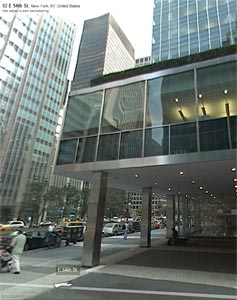
Lever House
Lever House gezien vanuit Google Streetview
Op de achtergrond Seagram Building
Lever House‘s innovative geometry has been much copied elsewhere: the tall slab of the office tower occupying only part of the site’s area, and offset by the horizontal slab of the base. Here the base is a single-story mezzanine, supported by columns around the perimeter and providing a public pedestrian area beneath. The lowest floor of the tower is recessed, emphasizing the geometric relationship of the two slabs.
 
Bron: Lever Building
Seagram Building
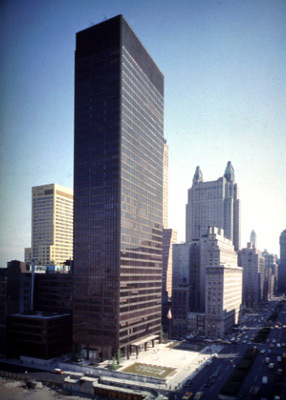
Seagram Building (1958)
The fame of the Lever House in the 1950s was matched by the Seagram Building in the 1960s. This steel skeleton framed skyscraper, headquarters of the Seagram Liquor Company, established the basic form of the corporate tower for years to come. Like Lever House, the curtain wall tower is not built to the edge of the site. It occupies only 40 percent of the allowable zoning envelope, freeing up space for a granite-paved public plaza enhanced by two reflecting pools and marble benches that is widely regarded as one of the most successful in the city. The plaza is an expensive aesthetic and symbolic gesture, especially significant in the dense urban environment which surrounds it.
 
Bron: Seagram Building
De gevolgen hebben van Seagram, hoewel het een groot kunstwerk is, een slecht voorbeeld gemaakt

Paul Goldberger

Seagram Building
Seagram Building
met de markante plaza die het gebouw aan de Park Avenue laat inspringen

Lever House | Seagram Building

Hotel 57

Terug naar Hotel 57 in New York

NYCNegen jaar geleden gingen we er nog voor naar New York, maar tegenwoordig kan het virtueel: een architectuurexcursie maken door de nauwe straten van Manhattan dankzij Google streetview en nyc-architecture.com. Met de pijltoetsen op het toetsenbord kun je virtueel om je heen en vooral omhoog kijken. Dat voorkomt de nodige nekkramp, die elke niet-New Yorker in Manhattan onherroepelijk krijgt. Toen ik er toch was, besloot ik eens in de buurt van het hotel rond te kijken waar we precies negen jaar geleden een paar nachten logeerden. Hotel 57 (130 East 57th Street, NY 10022) ligt op het kruispunt van 57th Street en Lexington Avenue (East Side of Midtown Manhattan) Niet alleen het hotel van binnen, maar ook het uitzicht is veranderd. De 246 meter hoge Bloomberg Tower staat nu een blok verder.

NYC
Hotel 57 vanaf de Lexington Avenue
Hotel 57 ligt in het hart van de East Side in het centrum van Manhattan. Het heeft een renovatie ondergaan van 22 miljoen dollar en is nu een van de mooiste boetiekhotels in New York City. Sereen. Werelds. En voorzien van 199 volledig vernieuwde kamers en suites met op maat gemaakte meubels en de modernste faciliteiten. U bevindt zich op steenworp afstand van enkele van de mooiste designerwinkels, de beste restaurants en alle grote bezienswaardigheden van Manhattan.
 
Bron: marriott.com
NYC
Op de achtergrond de Bloomberg Tower
(246 m.) die er in 2000 nog niet stond…
One Beacon Court (also called the Bloomberg Tower), is a skyscraper on the East Side of Midtown Manhattan, New York City. It houses the headquarters of Bloomberg L.P. in the lower floors and luxury condominiums in the higher floors. It is located at 731 Lexington Avenue between East 58th and 59th streets. Built on the site of the flagship Alexander’s Department Store which was torn down in 2000. The mid-block public space at the base of the building is called Beacon Court. The building stands at 54 stories tall, reaching 806 feet (246 meters). Construction started in 2001 and was completed in 2005. It is currently the 14th tallest building in New York and the 42nd tallest in the United States. The building’s zip code is 10022. Several buildings were demolished to make way for the Bloomberg Tower (the tallest being the Barclay-Garrett Building).
 
Bron: Bloomberg Tower
NYC
De ligging van Hotel 57

architectuur in Midtown Manhattan [ nyc-architecture.com ]