Categorie archief: schilderkunst

oorlogsschilder [ 1 ]

Paul Nash was tijdens de Eerste Wereldoorlog officieel oorlogskunstenaar
paul nash
The Mule Track (1918)
“Alleen de zwarte regen uit de gekneusde en gezwollen wolken, de hele bittere zwarte nacht lang, is het geschikte decor voor dit land. De regen jaagt voort, de stinkende modder wordt nog giftiger geel, de inslagkraters lopen vol met groen-wit water, de wegen en paden zitten onder een centimeter dikke slijklaag, de stervende zwarte bomen druppen en zweten, en er komt geen einde aan de granaten. Ze rukken de rottende boomstammen uit, breken de loopplanken, vellen paarden en muilezels, vernielen, verminken en maken gek, ze storten zich op het graf dat dit land is geworden – één reusachtig graf – en gooien er de arme doden op neer. Het is onnoemelijk, goddeloos, hopeloos. Ik ben niet langer een geïnteresseerd kunstenaar, ik ben een boodschapper die de woorden van de mannen aan het front overbrengt naar degenen die willen dat de oorlog voor altijd blijft duren. Mijn boodschap zal zwak zijn en onverstaanbaar, maar ze zal een bittere waarheid bevatten. Dat ze hun verdorven zielen moge verschroeien.”
 
Brief van Paul Nash, 18 november 1917
paul nash
We are making a new world

Paul Nash (1889 – 1946)
At the outbreak of World War I, Nash enlisted in the Artists’ Rifles and was sent to the Western Front in February 1917 as a second lieutenant in the Hampshire Regiment. A few days before the Ypres offensive he fell into a trench. He broke a rib and was invalided home. While recuperating in London, Nash worked from his front-line sketches to produce a series of drawings of the war. This work, which shows the influence of Blast and the Vorticist movement, was well-received when exhibited later that year at the Goupil Gallery.

As a result of this exhibition, Charles Masterman, head of the government’s War Propaganda Bureau (WPB) recruited Nash as an official war artist. In November 1917 he returned to the Western Front where his drawings resulted in his first oil paintings. Nash’s work during the war included The Menin Road, We Are Making a New World, The Ypres Salient at Night, The Mule Track, A Howitzer Firing, Ruined Country and Spring in the Trenches. They are some of the most powerful and enduring images of the Great War painted by an English artist.

Bron: en.wikipedia.org

Breughel
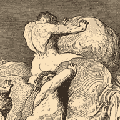
Triomf van de dood (detail), 1562
Pieter Breughel zag 355 jaar voor de hel van Passendale deze apocalyps

Paul Nash [firstworldwar.com]

de zomer van Piero

Piero della Francesca e la corti Italiani
tentoonstelling t/m 22 juli in drie musea in Umbrië

geboortePiero della Francesca (ca. 1416 – 1492) is in de twintigste eeuw waarschijnlijk populairder geworden dan Rafaël. Zijn werk oogt verrassend modern. Monumentaal, streng van vorm en met een mysterieuze afstandelijkheid van zijn figuren, spreken zijn fresco’s en panelen de meesten van ons direct aan. Een van zijn mooiste werken en een van de mooiste voorstellingen van de geboorte van Christus die ik ken, hangt in de National Gallery in Londen. Alles en iedereen staat hier zo op zijn en haar plek (ook de ekster links op het dak hoort er helemaal bij). En dan die eigenaardige voorgrond. Waarom geen mooie egale grasmat zoals bij Rafaël, maar deze archipel van graspollen? Heeft de schilder met deze verscheurde grasmat, de verscheurdheid van de wereld willen verbeelden waarin God mens wordt? Voor het beeld maakt de interpretatie weinig uit: visueel blijft de verbrokkeling op de voorgrond intrigerend terwijl het totale beeld toch grote helderheid blijft uitstralen.

Arezzo, San Sepolcro en Monterchi
Arezzo, Sansepolcro en Monterchi
liggen ten oosten van Florence en Siena

Deze zomer is in Umbriëde tentoonstelling Piero della Francesca e la corti Italiani te zien. Drie musea doen mee: het Museo Statale d’Arte medievale e Moderna in Arezzo , het Museo Civico in Sansepolcro en in het Museo Madonna del Parto in Monterchi.

hertog van Urbino
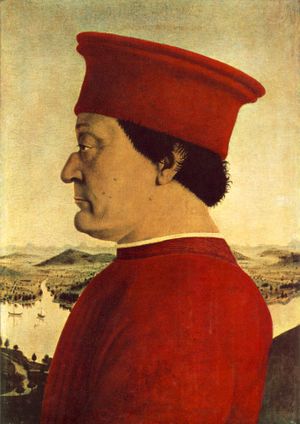
de hertog Federico da Montefeltro
Piero della Francesca
Madonna del Duca da Montefeltro
op de voorgrond herkennen we de hertog (klik op afbeelding voor 848 x 1200 pixels)

Piero della Francesca (ca. 1416 – 1492) was een Italiaanse kunstenaar wiens werk door zijn interesse voor wiskunde wordt gekenmerkt, in het bijzonder in verband met perspectief en het werken met diepte. Hij schreef een verhandeling De prospectiva pingendi over hoe de regels van wiskundige diepte op ieder voorwerp zouden kunnen worden toegepast, bijvoorbeeld op een kubus of menselijk hoofd. Minder duidelijk in zijn werk is zijn significante bijdrage tot de „humanistische“ vertolking van figuren in specifiek het schilderen van zijn vertolkingen van Christus. Het grootste deel van zijn leven bracht hij door in Arezzo en zijn geboortestad, Borgo San Sepolcro in Toscane. Hij studeerde onder Domenico Veneziano in Florence. Eén van Francesca’s bekendere studenten is de architect en schilder Donato Bramante.

Bron: nl.wikipedia.org

pierodellafrancesca.it | mostrapierodellafrancesca.it
Piero della Francesca in de Web Gallery of Art

plein air

pleinair schilders in de Verenigde Staten
Painting from life is a pursuit unlike any other painting technique. It challenges artists to concentrate every sensory nerve on the information in front them. They absorb it all, from sight to sound, from temperature to atmosphere, and then channel those feelings from head to hand, re-creating the vision in paints on paper or canvas.
 
Scott BurdickThe roots of painting from life are found in 19th-century Europe. Englishman John Constable believed the artist should forget about formulas and trust his own vision in finding truth in nature. To find that truth, he made sketches outdoors, then elaborated on them in the studio.
 
Around the same time in France, in a small village outside Paris called Barbizon, a group of artists focused their attentions on peasant life and the natural world surrounding it. Like Constable, Francois Millet and Gustave Courbet challenged conventions of the day, choosing everyday subjects rather than the traditional cliches and presenting them in natural settings, the information for which came from sketches made in the field.
We paint from life in order to learn how to see. If you can paint light, you can paint everything under the sun.

Frank LaLumia

These realists, as they came to be called, laid the groundwork for the mid-19th century revolution in France that took painting from life to its logical conclusion. Lead by Edouard Manet, Claude Monet, Edouard Degas, Auguste Renoir, et. al. the impressionists espoused the belief that you should trust your eyes. Using newly developed theories of how the eye physically registers color, they maintained that what you saw in nature was not form, but rather light on form. And light could be conveyed by color. To prove their theories, they took their paint tubes and easels outdoors, where they re-created the world as colors which suggested light. Rebuffed at first for what appeared to be unfinished paintings, the impressionist vision soon became a standard for truthfully conveying the outdoor experience.
 
Matt SmithPainting en plein air (in the open air) would forever change how we see the world. Artists in the United States were attracted to the concept, and many, like Californian Guy Rose, traveled to France to study with Monet. Suddenly, places with remarkable light were of particular interest to painters, including the both the East and West Coasts, and the American Southwest, where painting colonies formed. The goal of teachers and students alike was to capture the light and colors peculiar to the place.
 
Today, painting from life is a pursuit that continues to challenge the finest artists in the world, and no group is better known for upholding that credo than the Plein-Air Painters of America.
 
Bron: www.p-a-p-a.com

Plein Air Painters of America