is een illustrator uit Manchester
website van Phil Wrigglesworth
De reis naar Italië was in de negentiende eeuw niet alleen voor veel Europese schilders een (bijna) verplicht nummer, ook in de Verenigde Staten maakten veel schilders de reis naar het oude Europa. Een van hen was de van origine Engelse Thomas Cole die tussen 1829 en 1831 o.a. in Italië verbleef. Bij zijn terugkeer in de Verenigde Staten zou hij aan het begin staan van de zgn. Hudson River School. De schilders van deze school keerden bewust Italië en het oude Europa de rug toe en verheerlijkten de imponerende Amerikaanse wildernis met schilderijen in even imponerende formaten.
Voor de identiteit van de jonge Verenigde Staten hadden deze majestueuze natuurtaferelen bijzondere betekenis. Zo wilde men graag geloven dat de ongerepte natuur die men aan de overzijde van de oceaan aantrof, zonder sporen van beschaving, laat staan van verwoestende industrialisering, een aards Paradijs was dat de Schepper persoonlijk aan de Amerikanen geschonken had. Het was voor de jonge Verenigde Staten de compensatie van het gebrek aan verleden en cultuur. God had de Amerikanen bevoorrecht door hen te laten delen in de ongereptheid van Zijn Schepping.
Arthur Danto
Thomas Cole was born in 1801 at Bolton, Lancashire in Northwestern England and emigrated with his family to the United States in 1818. During the early years Cole lived for short periods in Philadelphia, Ohio, and Pittsburgh where he worked as an itinerant portrait artist. Although primarily self-taught, Cole worked with members of the Philadelphia Academy, and his canvases were included in the Academy’s exhibitions. In 1825, Cole discovered the haunting beauty of the Catskill wilderness. His exhibition of small paintings of Catskill landscapes came to the attention of prominent figures on the New York City art scene including Asher B. Durand, who became a life-long friend, and his fame spread. While he was still in his twenties, Cole was made a fellow of the National Academy.
In 1829-1831, Cole returned to Britain for study and to attend to family business and to travel to France and Italy. These years were among the most happy and productive of his life. Cole met a large number of wealthy Americans traveling abroad and received numerous commissions from them, increasing his reputation and stature. Cole returned to New York City in November of 1832 and mounted an exhibition of his European paintings, which aroused considerable public interest. Shortly thereafter, Cole first established his rural studio in Catskill, New York, when he rented a small outbuilding at Cedar Grove.
( Bron: thomascole.org )
Robert Hughes
Na Cole’s vroegtijdige dood in 1848 had hij nog geen opvolger als leider van de Hudson River School gevonden. Maar in 1857 maakte Frederick Edwin Church (1826-1900) in Amerika én Europa verpletterende indruk met zijn panorama van de Niagara Falls en bracht hij de Hudson River School tot een nieuw hoogtepunt.
Hudson River School
Asher B. Durand (1796-1886)
Thomas Cole (1801-1848)
John F. Kensett (1816-1872)
Martin Johnson Heade (1819-1904)
George Inness (1825-1894)
Frederick Church (1826-1900)
Albert Bierstadt (1830-1902)
In 1874 is de stijl van Millais helemaal veranderd. Zijn penseelstreek heeft zich verbreed en de kleuren zijn gedempter geworden. Het realisme wordt in Europa steeds meer geaccepteerd en in Frankrijk zijn de impressionisten al aan het doorbreken. Het onderstaande schilderij dat ook op de tentoonstelling in het Van Gogh Museum hangt, is eigenlijk een patriotisch schilderij. De North-West Passage duidt op de noordelijke (arctische) doorvaart naar de West Coast en het Verre Oosten. Een prestatie waarmee Brittania weer eens had bewezen dat het de golven van de wereldzeeën beheerste.
The north-west passage was the sea route round the north of the American continent which was thought to provide a passage to China and the East. Several arctic expeditions had tried and failed to find it. Millais painted this picture in 1874 just when another English expedition was preparing to set off on the same voyage.When the picture was shown at the Royal Academy in 1874 it was accompanied by the lines „It might be done, and England should do it„. This patriotic message is underlined by the presence of the Union Flag draped over a screen.
(Bron: tate.org.uk)
 In de voetsporen van Heidegger
 Voetnoten bij de 19e eeuw
 Amerikaanse Burgeroorlog
 Napoleon en zijn schilders
 Landschapsschilders uit de Goethezeit
 Schilders in Italië
 De schilder en zijn broodheer
 De waakzaamheid van het hart
 Ovidius’ Metamorphosen
 Dantes Divina Commedia
 Wolkenkrabbers
 Op zoek naar de atoomstijl
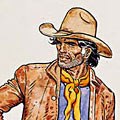 Een avontuur van luitenant Blueberry
 My favourite things