geluisterd naar Georges Brassens en Patachou
une magnifique chanson de Georges Brassens sur ses souvenirs d’enfance chantée par Patachou et lui-même. (1953)
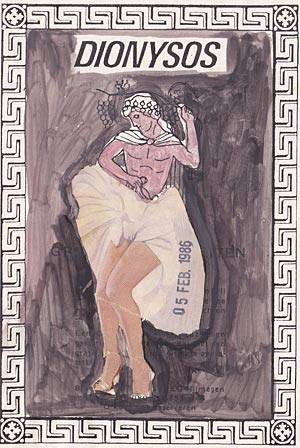
Dinsdag kwam ik op een donker plekje in huis een deel van een studie tegen over Dionysos (1931-1969) van de Hongaarse filoloog en mytholoog Károly Kerényi. Deze heb ik in 1985 gelezen toen ik mij op de kunstacademie bezig hield met het dionysische in de kunst. Tot mijn verrassing zat er een jeugdwerk in van vriend en studiegenoot René. Het Griekse restaurant Dionysos in Nijmegen bestaat overigens nog altijd.
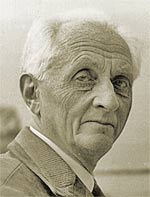 Károly Kerényi saw the theory of religion as a human and humanistic topic which coined his reputation as humanist further. So for him every view of mythology had to be a view of man – and hence theology always had to be at the same time anthropology. In this humanist spirit Kerényi defined himself as philological-historical as well as psychological scholar. In later years Kerényi evolved his psychological interpretation further and replaced the concept of archetypes with one that he labeled „Urbild„. This became particularly clear in some of his most important publications: Prometheus as well as especially in Dionysos, likely Kerényi’s most crucial work, which he had started as idea in 1931 and finished writing in 1969. Kerényi hence looked at the appearances in Greek religion not as curiosities, but as expressions of real human experience.
In navolging van het Duitse tv-programma Das Philosophische Quartett met Peter Sloterdijk en Rüdiger Safranski gaat omroep HUMAN vanaf 19 juni iedere zondagmiddag tussen 12.10 en 13.10 Het Filosofisch Kwintet uitzenden.
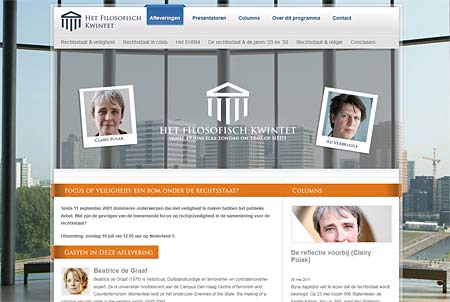
De eerste zes afleveringen hebben als thema ons idee van de rechtstaat. In Filosofie Magazine van juni staat een interview met de presentatoren Clairy Polak en Ad Verbrugge. Beiden krijgen regelmatig het verwijt moralistisch te zijn. De conservatieve denker Ad Verbrugge:
Ad Verbrugge in Filosofie Magazine
 In de voetsporen van Heidegger
 Voetnoten bij de 19e eeuw
 Amerikaanse Burgeroorlog
 Napoleon en zijn schilders
 Landschapsschilders uit de Goethezeit
 Schilders in Italië
 De schilder en zijn broodheer
 De waakzaamheid van het hart
 Ovidius’ Metamorphosen
 Dantes Divina Commedia
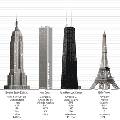 Wolkenkrabbers
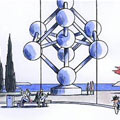 Op zoek naar de atoomstijl
 Een avontuur van luitenant Blueberry
 My favourite things