er was eens … [ 5 ]

Harry Clarke (1889-1931) uit Ierland
 

De periode 1870-1930 wordt wel eens The Golden Age of Illustration genoemd. Door het populaire Edwardian Gift Book was het geïllustreerde sprookjesboek in Engeland tot een uitzonderlijk hoog niveau gekomen. De meeste tekenaars die zo’n honderd jaar geleden actief waren, stonden onder invloed van het symbolisme en Jugendstil met zijn geaccentueerde lijnenspel. In deze serie vijf van deze illustratoren uit vijf verschillende landen die in hun unieke beeldtaal bekende sprookjes en sagen visualiseerden: Kay Nielsen, Edmund Dulac, Arthur Rackham, Ivan Bilibin en Harry Clarke.

By his late teens Harry Clarke was studying stained glass at the Dublin Art School. While there his The Consecration of St. Mel, Bishop of Longford, by St. Patrick won the gold medal for stained glass work in the 1910 Board of Education National Competition. Completing his education in his main field, Clarke travelled to London, where he sought employment as a book illustrator. Picked up by London publisher Harrap, he started with two commissions which were never completed: Samuel Taylor Coleridge’s The Rime of the Ancient Mariner (his work on which was destroyed during the 1916 Easter Rising) and an illustrated edition of Alexander Pope’s The Rape of the Lock. Difficulties with these projects made Hans Christian Andersen’s Fairy Tales by Hans Christian Andersen his first printed work, however, in 1916 a title that included 16 colour plates and more than 24 monotone illustrations. This was closely followed by an illustrations for an edition of Edgar Allan Poe’s Tales of Mystery and Imagination: the first version of that title was restricted to monotone illustrations, while a second iteration with 8 colour plates and more than 24 monotone images was published in 1923. The latter of these made his reputation as a book illustrator (this was during the golden age of gift-book illustration in the first quarter of the twentieth century: Clarke’s work can be compared to that of Aubrey Beardsley, Kay Nielsen, and Edmund Dulac). His work was influenced by both the passing Art Nouveau and coming Art Deco movements. His stained glass was particularly informed by the French Symbolist movement.
 
Bron: en.wikipedia.org
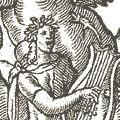
Harry Clarke
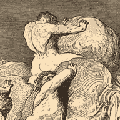
illustratie van Harry Clarke

Harry Clarke’s geillustreerde boeken (1916-1928)

The Rime of the Ancient Mariner van Samuel Taylor Coleridge (onvoltooid)
The Rape of the Lock van Alexander Pope (onvoltooid)
Sprookjes van Hans Christian Andersen (16 afbeeldingen in kleur en 24 in monotoon) (1916)
Tales of Mystery and Imagination van Edgar Allan Poe (1923)
The Years at the Spring (1920) (12 afbeeldingen in kleur)
Sprookjes van Charles Perrault
Faust van Goethe (1925) (8 afbeeldingen en kleur en 70 in mono- en duotoon)
A History of a Great House van Jameson Irish Whiskey (1924)
Elixir of Life van Geofrey Warren (1925)
Selected Poems van Algernon Charles Swinburne (1928)

Harry Clarke [ surlalunefairytales.com] | Harry Clarke Gallery | artpassions.net

er was eens … [ 4 ]

Ivan Bilibin (1876-1942) uit Rusland
 

De periode 1870-1930 wordt wel eens The Golden Age of Illustration genoemd. Door het populaire Edwardian Gift Book was het geïllustreerde sprookjesboek in Engeland tot een uitzonderlijk hoog niveau gekomen. De meeste tekenaars die zo’n honderd jaar geleden actief waren, stonden onder invloed van het symbolisme en Jugendstil met zijn geaccentueerde lijnenspel. In deze serie vijf van deze illustratoren uit vijf verschillende landen die in hun unieke beeldtaal bekende sprookjes en sagen visualiseerden: Kay Nielsen, Edmund Dulac, Arthur Rackham, Ivan Bilibin en Harry Clarke.

Ivan Bilibin
illustratie van Ivan Bilibin
Ivan Yakovlevich Bilibin was a 20th-century illustrator and stage designer who took part in the Mir iskusstva and contributed to the Ballets Russes. Throughout his career, he was inspired by Slavic folklore. Ivan Bilibin was born in a suburb of St. Petersburg. He studied in 1898 at Anton Ažbe Art School in Munich, then under Ilya Repin in St. Peterburg. In 1902-1904 Bilibin travelled in the Russian North, where he became fascinated with old wooden architecture and Russian folklore. He published his findings in the monograph Folk Arts of the Russian North in 1904. Another influence on his art was traditional Japanese prints. Bilibin gained renown in 1899, when he released his illustrations of Russian fairy tales. During the Russian Revolution of 1905, he drew revolutionary cartoons. He was the designer for the 1909 première production of Nikolai Rimsky-Korsakov’s The Golden Cockerel. The October Revolution, however, proved alien to him. After brief stints in Cairo and Alexandria, he settled in Paris in 1925. There he took to decorating private mansions and Orthodox churches. He still longed for his homeland and, after decorating the Soviet Embassy in 1936, he returned to Soviet Russia. He delivered lectures in the Soviet Academy of Arts until 1941. Bilibin died during the Siege of Leningrad.
 
Bron: en.wikipedia.org


Ivan Bilibin [ surlalunefairytales.com ]
| artpassions.net

Jezus & Mohammed

De Washington Post weigerde artikel van Willis E. Elliott

Willis E. Elliot“Rel in VS over artikel islam” kopt het Nederlands Dagblad vandaag op de voorpagina. Verderop in de krant is een Nederlandse vertaling te lezen van het artikel van de baptistenpredikant Willis E. Elliott dat door de Washington Post geweigerd is. Amerikaanse websites, waaronder pajamasmedia.com, die voor de vrijheid van meningsuiting willen opkomen, hebben het artikel van Elliott daarna integraal geplaatst.

Omdat Jezus een mislukkeling was en Mohammed juist succes had, leerden christenen vanaf het begin wat het is om een religieuze minderheid te zijn en overleefde Jezus„ falen alleen vanwege het feit dat Hij niet dood bleef.

Willis E. Elliott

Blasphemy (irreverent speech or action against a deity or religious person/belief/object) is currently in the news only when Muslims become violent, or threaten violence, when they feel offended: when we Christians feel offended, almost never do we become violent, and almost always we suffer the disrespect in silence. In the New Testament (and other early Christian literature), much is said about nonviolence, never is violence commanded or even suggested; it is forbidden. Not so, early Muslim literature. The contrast is to be expected: Jesus was anti-violent, Muhammad was violent (a military leader as well as a religious leader).
 
Bron: pajamasmedia.com

The True Islamophobia at the Washington Post | Nederlands Dagblad
Willis E. Elliott On Faith [ Washington Post ]