Gregorios Palamas sluit de Philokalia (Deel IV) af met zes geschriften. Hij is vooral bekend geworden door zijn dispuut met de monnik Barlaam over het Ongeschapen Licht. Zijn betekenis voor de Orthodoxie is zo groot dat de Kerk de Tweede Zondag in de Grote Vasten de Zondag van Gregorios Palamas genoemd heeft.
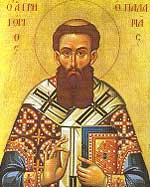 Contrary to Barlaam, Gregory asserted that the prophets in fact had greater knowledge of God, because they had actually seen or heard God himself. Addressing the question of how it is possible for humans to have knowledge of a transcendent and unknowable God, he drew a distinction between knowing God in his essence (in Greek, ουσια) and knowing God in his energies (in Greek, ενεργειαι). He maintained the Orthodox doctrine that it remains impossible to know God in his essence (God in himself), but possible to know God in his energies (to know what God does, and who he is in relation to the creation and to man), as God reveals himself to humanity. In doing so, he made reference to the Cappadocian Fathers and other early Christian writers.
Bron: orthodoxwiki.org
Tropaar [Toon 8]
O light of Orthodoxy, teacher of the Church, its confirmation,
O ideal of monks and invincible champion of theologians,
O wonder working Gregory, glory of Thessalonica and preacher of grace,
always intercede before the Lord that our souls may be saved.
Kondaak [Toon 8]
Holy and divine instrument of wisdom,
joyful trumpet of theology,
together we sing your praises, O God-inspired Gregory.
Since you now stand before the Original Mind,
guide our minds to Him, O Father,
so that we may sing to you: “Rejoice, preacher of grace.”
He continually stressed the Biblical vision of the human person as a united whole, both body and soul. Thus, he argued that the physical side of hesychastic prayer was an integral part of the contemplative monastic way, and that the claim by some of the monks of seeing the uncreated light was indeed legitimate. Like St. Simeon the New Theologian, he also laid great stress in his spiritual teaching on the vision of the divine light.
Bron: orthodoxwiki.org
werken van Gregorios Palamas in de Philokalia (Deel IV)
To the Most Reverend Nun Xenia
A New Testament Decalogue
In Defence of Those who Devoutly Practise a Life of Stillness
Three Texts on Prayer and Purity of Heart
Topics of Natural and Theological Science and on the Moral and Ascetic Life: 150 Texts
The Declaration of the Holy Mountain in Defence of Those who Devoutly Practice a Life of Stillness
 There are three methods of prayer and attentiveness, by means of which the soul is either uplifted or cast down. Whoever employs these methods at the right time is uplifted, but whoever employs them foolishly and at the wrong time is cast down. Vigilance and prayer should be as closely linked together as the body to the soul, for the one cannot stand without the other. Vigilance first goes on ahead like a scout and engages sin in combat. Prayer then follows afterwards, and instantly destroys and exterminates all the evil thoughts with which vigilance has already been battling, for attentiveness alone cannot exterminate them. This, then, is the gate of life and death. If by means of vigilance we keep prayer pure, we make progress; but if we leave prayer unguarded and permit it to be defiled, our efforts are null and void.