Categorie archief: architectuur

hoog, hoger, hoogst [7]

De ontwikkeling van de skyline van Lower Manhattan vanaf 1900

Vorige week ben ik in de geschiedenis van de wolkenkrabber gedoken. De wolkenkrabber is in Chicago ontstaan, maar heeft zich sinds 1890 juist in New York kunnen ontwikkelen. Persoonlijk vind ik het interessant hoe in dit onderdeel van de architectuurgeschiedenis, de vorm nog een poosje achterblijft bij de functie. Hoewel Louis Sullivan al aan het einde van de 19e eeuw het axioma van het modernisme Form Follows Function formuleerde, bleef de hoogbouw nog tot in de Eerste Wereldoorlog historische stijlen citeren.

Lower Manhattan omstreeks 1900
Klik op foto voor vergroting

Er is op het web een schat aan informatie te vinden over de geschiedenis van de wolkenkrabber. Ik besluit deze reeks met drie panoramafoto’s van de skyline van New York. Deze foto’s zijn allemaal te vinden op de website van vazyvite.com

Lower Manhattan West omstreeks 1907
Klik op foto voor vergroting
Lower Manhattan omstreeks 1909
Het Singer Building is hier nog de hoogste
Klik op foto voor vergroting

Vergelijk de skyline van Lower Manhattan vlak voor en na 11 september 2001.

hoog, hoger, hoogst [6]

De eerste negentiende eeuwse wolkenkrabbers in New York
Newspaper Row, een schitterend historisch straatbeeld van New York aan het einde van de 19e eeuw. Links met koepel het New York World Building, in 1890 nog het hoogste gebouw van New York en hoogste kantoorgebouw ter wereld.
Located at the corner of Park Row and the now closed Frankfort Street, the New York World Building was the tallest of several high-rise structures built for major newspapers in the late 19th century. Commissioned by the famous editor Joseph Pulitzer and designed by the prolific architect George B. Post, the World (also known as Pulitzer Building) was the first building in New York to surpass the 284-foot spire of Trinity Church. It stretched 309 feet to the top of the lantern (measured from the steep grade of Frankfort Street rather than the main frontage on Park Row). The number of stories is disputed; estimates range from the 26 stories claimed by the World to the 16 or 18 suggested by recent scholars. Pulitzer placed his private office at the second level of the dome where he could easily look down on the other buildings of Newspaper Row. The paper used the lower floors and basements for its large presses and the sunlit top floors for copy-editing; the remainder were rented out to tenants, generating income for the World.
 
The structural system of the World Building was a hybrid “cage” frame. Steel framing was used to support the interior structure, but the exterior masonry walls contributed lateral stability and some vertical support. Columns embedded in the exterior walls carried the floor loads, transferring lateral forces between the frame and the masonry. The facade was red sandstone, brick and terra-cotta, with red and gray granite at the arched entryway. In 1890, the building’s height appalled some critics who called it “high-shouldered” and “hideous.” The World Building was demolished in 1955 for the expanded automobile entrance to the Brooklyn Bridge.

19th Century Skyscrapers

hoog, hoger, hoogst [5]

Twee laat-negentiende eeuwse wolkenkrabbers in New York

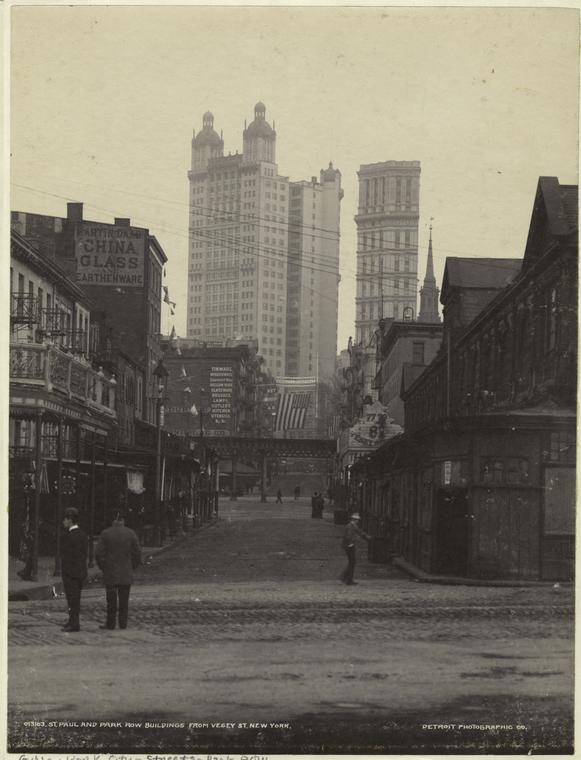
Een van de eerste wolkenkrabbers in New York dateert nog uit de negentiende eeuw. In 1899 nam het 117 meter hoge Park Row Building de titel world’s tallest building over van zijn buurman St.Paul Building.

Park Row Building, 1899
Tot 1908 het hoogste gebouw ter wereld. Rechts St.Paul’s Building dat in 1898 nog deze titel droeg.
The 30-story Park Row Building was the tallest office building in the world from the time of its completion until the completion of the Singer Building in 1908. Built as a speculative office building by a syndicate of investors lead by August Belmont (also the entrepreneur behind the Interborough Rapid Transit Company (IRT), a private company responsible for the building and operation of the original subway line) the office block originally accommodated 950 offices and over 4,000 workers. It exploited the newly developed all steel-skeleton technology. The syndicate bought and consolidated seven smaller lots to create this large but very irregularly shaped site which lacked the corner lot. The exterior lacks the soaring profile and slender tower of the office buildings that would take the title of tallest building in the next decade, the Singer Building, Metropolitan Life Tower and Woolworth Building. The most distinctive elements of its design are the two three-story cupolas and four life-sized sculpted figures projecting from the fourth floor of the Park Row front.
 
Bron: nyc-architecture.com
Nogmaals de kampioenen van 1898-1908 samen op een ansichtkaart.
The Park Row Building still stands today facing City Hall Park in lower Manhattan. Commissioned in 1896 by William Mills Ivins, the head of an investment group, the structure was built as speculative office space. It rises 386 feet to its cornice and 391 feet to the lanterns placed atop the structure; counting the four stories in the lanterns, the building is 30 stories tall. The interior could accommodate up to 1,000 offices, and was the home of the first IRT subway headquarters. Under the direction of architect R.H. Robertson and engineer Nathaniel Roberts, the building was under construction for over three years.
 
Bron: skyscraper.org

Een aardig overzicht van wolkenkrabbers in New York met actuele foto’s vind je hier

nyc-architecture.com | skyscraper.org