catalogus uitgegeven ter gelegenheid van de Europalia 1998 in Brussel
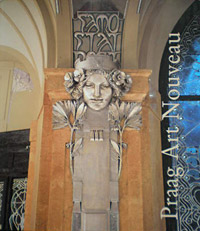 Michaela en ik houden allebei van de natuur en van kunst, dus het is logisch dat we ook allebei van Art Nouveau houden. Inmiddels is ons rijtje Jugendstilboeken een rij geworden en kunnen we gewapend met enige voorkennis op Jugendstilbedevaart gaan naar Brussel, Nancy of Praag. In de laatste stad was ik vijftien jaar geleden met een toenmalige vriendin. We bezochten daar o.a. het schitterende U Obecni dum (gemeentehuis) van de achitecten Antonin Balsanek en Osvald Polivka dat in de jaren 1903-1905 gebouwd werd en waaraan veel kunstenaars hebben bijgedragen, waaronder ook Alphonse Mucha. In het boek Art Nouveau Praag staat dit pareltje van Gesammtkunst uiteraard ook vermeld. Op de website Art Nouveau Worldwide, een soort reisgids voor Jugendstil ontbreekt Praag ook niet. Liefhebber Frank Derville die deze site beheert, geeft zijn Top 5 voor Praag met Hotel Central (1902 – Hybernska ulice 10), Hotel Europa (1906 – Vaclavske namesti 25), U Novaku ( 1904 – Vodickova ulice 30), St Vitus cathedral (Hrad, III nadvori), U Obecni dum (1905 – namesti Republiky 5), Central Station (1909 – Wilsanova trida).
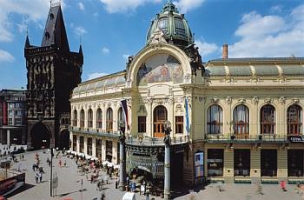
The Municipal House (U Obecni Dum) is one of the most remarkable constructions of Prague Art Nouveau. At the time of its creation it was critisized by some architects as its style was considered to be formally outdated. The lapse of almost a century since then allows us to forget about the emotions and controversy of those times and to appreciate this building as a unique harmony of architectural and painting styles of the turn of the 19th and 20th centuries. Neo-Baroque, Neo-Renaissance, and both Western and Oriental influences fuse together with Czech Art Nouveau. The impression this building gives is enhanced by a wide range of decorative styles and materials, as well as by the high quality of craftmanship. The monumental appearance of the building is crowned by the outstanding decor created by most of the prominent Czech artists of the day, namely the painters Mikolas Ales, Vaclav Jansa, Alfons Mucha, Jakub Obrovske, Jan Preisler, Josef Wenig, Karel Spillar, Max Svabinske, Josef Ullman, Frantisek Zenísek, and the sculptors Josef Maratka, Josef Vaclav Myslbek, Karel Novak, Ladislav Saloun, Frantisek Uprka, Bohumil Kafka and Cenek Vosmík.
Bron: obecnidum.cz
Art Nouveau World Wide | The Municipal house – U Obecni Dum [obecnidum.cz]
Art Nouveau [ metmuseum.org ]
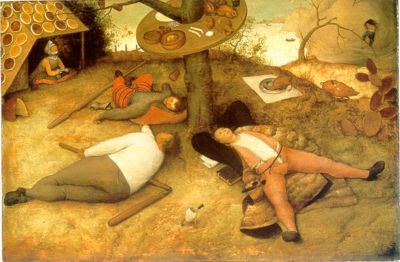
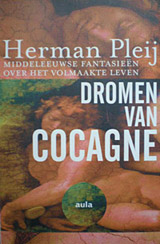 Hoe lijvig zijn studie ‘Dromen van Cocagne‘ ook is, bijna vijfhonderd bladzijden, men hoeft zich geen ogenblik te vervelen, want er blijken telkens nieuwe, onverwachte kanten te zitten aan Cocagne. De voorstelling van een droomland, een paradijs waar niemand zelfs ook maar iets mag uitvoeren en waar de gebraden duifjes de bewoners vanzelf de geopende mond in vliegen, waar de muren gemaakt zijn van worsten, de huizen bedekt zijn met vlaaien, de rivier van heerlijke wijn is en waar men in een verjongingsbron drieëndertig jaar kan worden – zo’n voorstelling is al oud en heeft een lange orale geschiedenis. Ook in andere landen, zoals Frankrijk, Duitsland, Ierland. Zelfs de antieken hadden vergelijkbare voorstellingen.
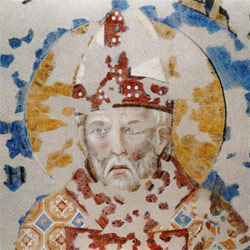 De Italiaanse fotograaf Ghigo Roli werkte in 1997 aan een complete inventarisering van de wereldberoemde fresco’s van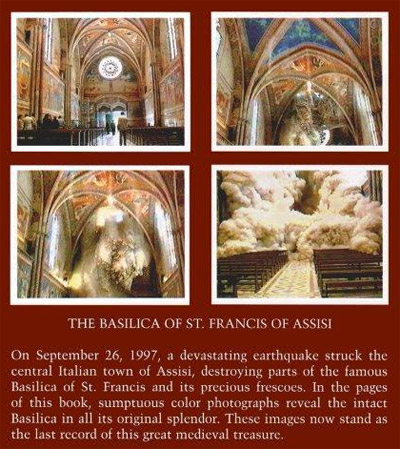
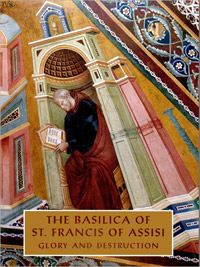 After several seismic tremors in Umbria and the Marche in the preceding days, the strongest earthquake occurred on the morning of September 26, 1997. The earthquake not only tragically killed four people, but also caused severe damage and destruction in the upper church of San Francesco. Serious static damage was found in the walls and the vault. The morning earthquake destroyed around 200 square metres of vault frescoes. In the front bay arch above the entrance, four of the eight pairs of saints by Giotto were affected, and in the adjoining vault of the Doctors of the Church, the field containing St. Hieronymus, also a work by Giotto and his workers, collapsed and left a huge hole in the first bay. In contrast, the vault of the second bay and the vault of the third bay, containing the large deesis portraying Christ as the redeemer together with the advocates Mary and John on either side of St. Francis, remained intact. However, the western part of the fourth bay with a starry sky and the adjoining evangelists„ vault with frescoes by Cimabue above the cross-vault collapsed. The field containing St. Matthew was almost completely destroyed.