Categorie archief: geschiedenis

Poussin aan de Missouri

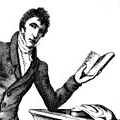
de Amerikaanse schilder George Caleb Bingham (1811-1879)

Vorig jaar schreef ik hier iets over de wisselwerking tussen Amerikaanse en Duitse schilders in de negentiende eeuw. De kunstacademie van Düsseldorf speelde in het midden van de negentiende eeuw een sleutelrol. De Amerikaanse schilder Emanuel Leutze schiep hier in 1851 het icoon van de Amerikaanse schilderkunst, Washington’s oversteek over de ijzige Delaware. Een andere Amerikaanse schilder George Caleb Bingham zocht hem in 1856 in Düsseldorf op en schilderde kort daarna zijn eigen versie op dit heldhaftige moment in de Amerikaanse geschiedenis. Maar Bingham ontbrak het talent als historieschilder. Hij was veel meer een genreschilder.
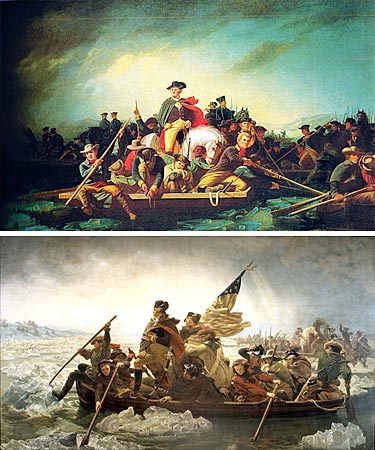
Washington Crossing the Delaware
Leutze schilderde hét heroïsche moment uit de Amerikaanse geschiedenis in Düsseldorf (onder)
Bingham schilderde hetzelfde thema (boven) maar door de felle kleuren, stijfheid van de figuren en compositie is het schilderij eerder naïef dan heroïsch te noemen.

The Düsseldorf School had a significant influence on the Hudson River School in the United States, and many prominent Americans trained at the Düsseldorf Academy and show the influence of the Düsseldorf School, including George Caleb Bingham, Eastman Johnson, Worthington Whittredge, Richard Caton Woodville, William Stanley Haseltine, James McDougal Hart, and William Morris Hunt, as well as German émigré Emanuel Leutze. Albert Bierstadt applied but was not accepted. His American friend Worthington Whittredge became his teacher while attending Düsseldorf. Bron: en.wikipedia.org

Bingham‘s bekendste schilderij is het verstilde moment met twee bonthandelaren in hun bootje op de Missouri uit 1845. Het is een eenvoudig en uitgebalanceerd tafereel. Vanwege zijn gepolijste en afgewogen manier van schilderen, wordt Bingham wel eens met Nicolas Poussin vergeleken.
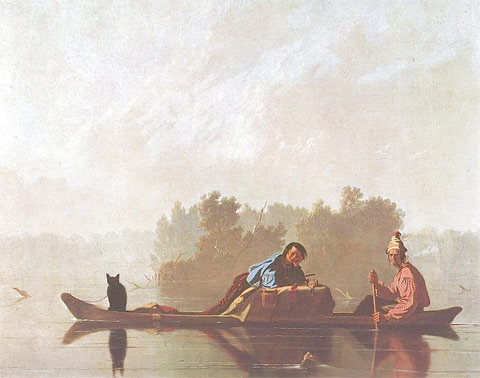
Fur Traders, 1845
Fur Traders Descending the Missouri
Bingham’s bekendste schilderij uit 1845
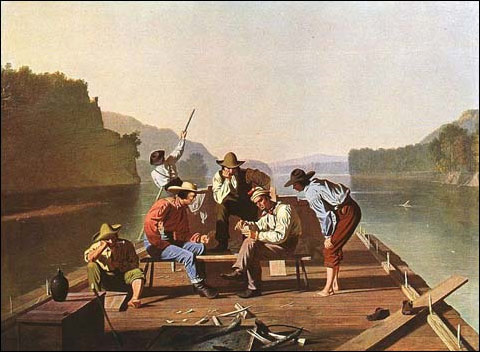
His genre paintings -narratives of everyday life- depicted and immortalized the common man: fur traders and riverboatmen and settlers in scenes of frontier life
George Caleb Bingham (1811-1879) is renowned today as one of the classic artists of the American West. His paintings rank among the nation’s greatest art treasures. Bingham can lay claim to being the first outstanding American artist from the “West“. He is best known for his genre scenes derived from the daily life of what was then the Western frontier. Lewis and Clark and the Corps of Discovery had returned from their 1804-06 westward exploration only five years before Bingham was born. In 1820, when Bingham was nine, Missouri became the 24 th state. Bingham’s paintings from 1845-55 the decade of his best work generally relate to life and commerce along the Mississippi and Missouri rivers, and to the American scene involving the people of Missouri in and around St. Louis, Columbia, Jefferson City, Arrow Rock, Boonville, and Kansas City. His genre paintings -narratives of everyday life- depicted and immortalized the common man: fur traders and riverboatmen and settlers in scenes of frontier life (which he knew from both tradition and first hand observation); and scenes of the young nation’s democratic process: political campaigning and elections (which he knew from his deep involvement with the Whig party, with Missouri state politics and national politics, and as a seeker and achiever of political office).
Bingham
Raftsmen Playing Cards, 1847
In 1856, Bingham with his wife and daughter Clara sailed for Europe, first to Paris, which he found alien and inhospitable and expensive and even the Louvre disconcerting. George and his family then went on to a sojourn in Dusseldorf, where he completed full-length portraits of Washington and Jefferson (a commission from the Missouri State Legislature, both now destroyed by fire); the second of three related flatboatmen paintings, “Jolly Flatboatmen in Port“ (1857); “Moonlight Scene: Castle on the Rhine“(1857, Private Collection); and probably other unrecorded works. Düsseldorf , compared to Paris, was a manageable city of 30,000 and a famous art center that had attracted, interestingly enough, such aspiring German-American artists as Emanuel Gottlieb Leutze, Carl Wimar, and Albert Bierstadt all of whom had been born in Germany and emigrated to the United States as children, only to return to Germany to study and in Leutze’s case to live in Düsseldorf for many years where he also became a noted teacher. From the 1840s through the 1850s other American artists such as T. Worthington Woodridge, Richard Caton Woodville, and Eastman Johnson also studied in Düsseldorf. Leutze, as teacher and great friend of visiting American artists, was a first stop for American expatriates, and Bingham, although a mature and established painter, was no exception. George wrote to his friend Rollins back in Columbia, Missouri: “Immediately upon our arrival in Dusseldorf, I called upon Leutze, the famous painter, who received me as cordially as if I had been a brother, and without a moment’s delay assisted me in finding a Studio, and introduced me to one of his American pupils through whose guidance I shortly obtained accommodations of the best kind, and upon the most reasonable terms.“
 
Bron: en.wikipedia.org

georgecalebbingham.org

Rule Britannia

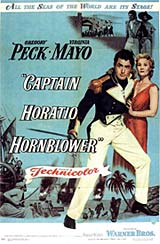
gezien: Captain Horatio Hornblower R.N. (1951)

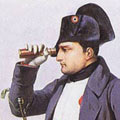
Captain Horatio HornblowerToen Patrick O’Brian in 1969 begon met zijn reeks historische romans over kapitein Jack Aubrey en zijn scheepsarts Stephen Maturin, nam hij het estafettestokje over van zijn landgenoot C.S. Forrester. Tussen 1937 en 1967 had deze elf romans geschreven over kapitein Horatio Hornblower. Jack Aubrey zou als opvolger van Horatio Hornblower de traditie van het Britse zeevaardersepos voortzetten. Patrick O’Brian schreef na C.S.Forrester nog eens dertig jaar romans die zich afspelen in de Royal Navy tijdens de Napoleontische oorlogen. Ditmaal aan boord van de HMS Surprise, het fregat van kapitein Jack Aubrey.
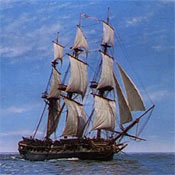
I find Hornblower admirable

Winston Churchill

Na Forrester en O’Brian gaat de traditie gewoon door. Zo heeft de Amerikaan Dewey Lambdin na de dood van Patrick O’Brian alweer acht romans geschreven over Alan Lewrie. Er kunnen hier nog twee andere schrijvers vermeld worden: Douglas Reeman. Onder het pseudoniem Alexander Kent schreef hij tussen 1975 en 2007 28 romans over over Richard Bolitho. Daarnaast Dudley Pope die tussen 1965 en 1989 18 romans publiceerde met Lord Ramage in de hoofdrol.

HMS LydiaHoratio Hornblower is a fictional Royal Navy officer who is the protagonist of a series of novels by C. S. Forester. He was later the subject of films and television programs. The original Hornblower tales began with the appearance of a junior Royal Navy Captain on independent duty on a secret mission to Central America, though later stories would fill out his earlier years, starting with an unpromising beginning as a seasick midshipman. As the Napoleonic Wars progress, he gains promotion steadily as a result of his skill and daring, despite his initial poverty and lack of influential friends. Eventually, after surviving many adventures in a wide variety of locales, he rises to the pinnacle of his profession, promoted to Admiral of the Fleet, knighted as a Knight Grand Cross of the Order of the Bath, and named the 1st Baron Hornblower.
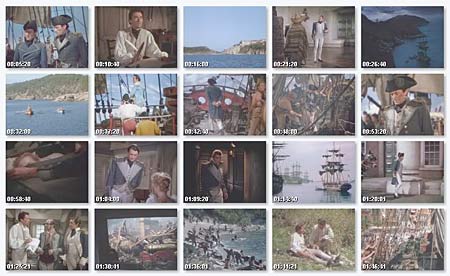
 
Bron: en.wikipedia.org
Hornblower
stills uit Captain Horatio Hornblower 1951

Hornblower romans van C.S.Forrester

The Happy Return (1937)
A Ship of the Line (1938)
Flying Colours (1938)
The Commodore (1945)
Lord Hornblower (1946)
Mr. Midshipman Hornblower (1950)
Lieutenant Hornblower (1952)
Hornblower and the Atropos (1953)
Hornblower in the West Indies (1958)
Hornblower and the Hotspur (1962)
Hornblower and the Crisis (1967, onvoltooid)

De film Capain Horatio Hornblower R.N. uit 1951 is gebaseerd op de eerste drie romans The Happy Return (1937), A Ship of the Line (1938) en Flying Colours (1938).

Na de film uit 1951 werden er naar de boeken van C.S.Forrester tussen 1998 en 2003 nog acht televisiefilms gemaakt onder de titel Hornblower.

Hornblower vs. Jack Aubrey [ historicnavalfiction.net ]

Amerikaanse Burgeroorlog [ 11 ]

gezien op DVD : Glory (1989)
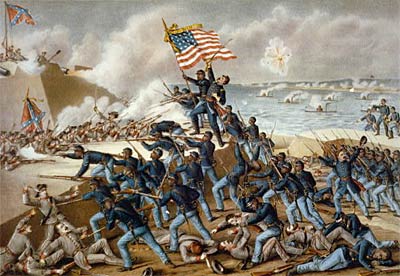
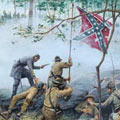
de aanval op Fort Wagner bij Charleston op 18 juni 1863

De Amerikaanse Burgeroorlog was een machtsstrijd tussen blanke mannen. Sinds decennia was er al een rivaliteit tussen de noordelijke staten en de zuidelijke staten, waarbij de afschaffing van de slavernij steeds meer als issue was gaan spelen. Door de industrialisering was het Noorden niet zoals het Zuiden afhankelijk van slavenarbeid. Toen in Engeland in 1834 de slavernij eindelijk werd afgeschaft, lieten de abolitionisten in Verenigde Staten steeds luider van zich horen. Maar het Zuiden liet zich door het Noorden niet de wet voorschrijven. Door de katoen was het Zuiden economisch volledig afhankelijk geworden van de slavernij. “Bemoei je niet met onze zaken!” was kort en duidelijk de boodschap van het Zuiden aan Washington.
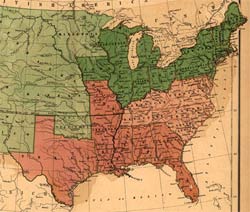
slavenvrije- en slavenstatenHalverwege de negentiende eeuw liepen de spanningen tussen Noord en Zuid steeds hoger op. Er was steeds een evenwicht gebleven tussen het aantal zuidelijke slavenstaten (rood) en de noordelijke slavenvrije staten (groen). Maar toen er met de uitbreiding ten westen van de Mississippi in de nieuwe territoria nieuwe staten werden gevormd, kwam men voor het probleem te staan of in deze staten wéll of geen slavernij zou moeten worden toegestaan. Deze open zenuw zette de verhouding tussen het Noorden en het Zuiden op scherp. Tussen 1854 en 1858 ontstond er in de nieuw te vormen staat Kansas een bendeoorlog tussen Jayhawkers en Buswhackers. Bleeding Kansas zou het voorspel van de Amerikaanse Burgeroorlog worden. De strijd bleef weliswaar beperkt tot het nieuwe territorium ten westen van de Mississippi en delen van Missouri, maar was zeer wreed voor de burgerbevolking die vaak tussen twee kampen in stond. In de film Ride with the devil die zich afspeelt in Kansas en Missouri, wordt dat realistisch getoond.
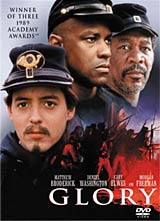
Glory DVDAfgelopen week zag ik dan eindelijk Glory, die door velen beschouwd wordt als de beste film die over de Amerikaanse Burgeroorlog gemaakt is. In tegenstelling tot veel andere Civil War movies werd er in de Verenigde Staten ook een flinke winst gemaakt op deze film. Ongetwijfeld komt dat doordat deze film politiek correct is. Niet toevallig is het ook een film die vooral vanuit het noordelijk perspectief gemaakt is. Een film waarin het meer gaat over de verbroedering van Noord en zwart dan om een broedermoord zoals in Gettysburg. In Glory krijgen de rebellen uit het Zuiden geen gezicht, zodat we de oorlog niet eens vanuit zuidelijk perspectief kunnen bekijken. Het Zuiden is de vijand. Punt. In dit opzicht is Gettysburg een meer genuanceerde film. Maar het is een hachelijke zaak voor filmproducenten om af te wijken van het standpunt van de overwinnaar, het Noorden. Dat heeft de producent van Ride with the devil geweten. In deze film vecht een slaaf vrijwillig met de witte man uit het Zuiden tegen het Noorden. Het Amerikaanse publiek strafte deze politieke incorrectheid genadeloos af. De laatste film bracht iets meer op dan een half miljoen dollar, terwijl aan Glory 63 miljoen dollar werd verdiend. De blanke man uit het Noorden heeft het sinds 1865 voor het zeggen. Maar Glory geeft ook kritiek op het Noorden. Veel ontsnapte slaven uit het Zuiden werden in zekere zin opnieuw slaaf, maar nu in het leger van de blanke man in het Noorden. De zwarte soldaten werden steeds als minderwaardig gezien en kregen bijvoorbeeld minder betaald dan de blanke soldaten.
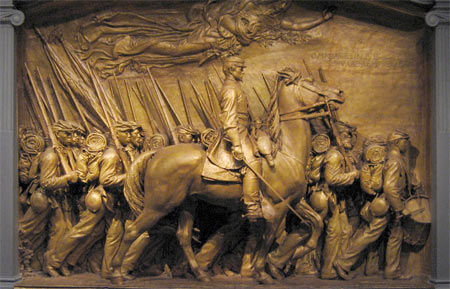
Robert Gould Shaw Memorial
door Augustus Saint-Gaudens, 1897
National Gallery of Art Washington

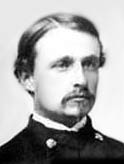
Glory gaat over de historische personage Robert Gould Shaw, die de leiding krijgt over de 54ste infanterie van Massachusetts. Het is een regiment dat enkel uit zwarten bestaat. Shaw en zijn regiment zijn onvergetelijk geworden door de heldhaftige bestorming van Fort Wagner op 18 juli 1863, krap drie weken na de slag bij Gettysburg. Shaw en honderden van zijn mannen kwamen hierbij om het leven, zonder dat het fort genomen wordt. In de National Gallery of Art in Washington worden zij geëerd met de Robert Gould Shaw Memorial, maar het mooiste monument is waarschijnlijk deze film.

Robert Gould ShawRobert Gould Shaw (1837-1863)
was the colonel in command of the all-black 54th Regiment, which entered the American Civil War in 1863. He was killed in a failed attempt to capture Fort Wagner, near Charleston, South Carolina. ( … )Shaw was approached by his father while in camp in late 1862 to take command of a new All-Black Regiment. At first he declined the offer, but after careful thought accepted the position. Shaw’s letters clearly state that he was dubious about a free black unit succeeding, but the dedication of his men deeply impressed him, and he grew to respect them as fine soldiers. On learning that black soldiers would receive less pay than white ones, he inspired his unit to conduct a boycott until this inequality was rectified. The enlisted men of the 54th Massachusetts Infantry (and the sister 55th) refused pay until Congress granted them full back pay at the white pay rate in August 1864.

The 54th Regiment was sent to Charleston, South Carolina, to take part in the operations against the Confederates stationed there. On July 18, 1863, along with two brigades of white troops, the 54th assaulted Confederate Battery Wagner. As the unit hesitated in the face of fierce Confederate fire, Shaw led his men into battle by shouting, “Forward, Fifty-Fourth Forward!” He mounted a parapet and urged his men forward, but was shot through the heart and he died almost instantly. According to the color Sgt of the 54th Mass, he was shot and killed trying to lead the unit forward and fell on the outside of the fort.
Bron: en.wikipedia.org

Fort Wagner
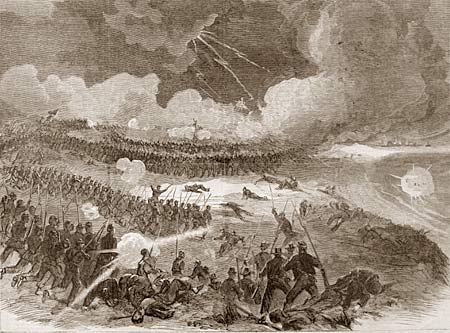
de aanval op Fort Wagner
in Harper’s Weekly 8 augustus 1863
Harper’s Weekly was het CNN van de Civil War
Just as darkness began to close in upon the scene of the afternoon and the evening, General Strong rode to the front and ordered his brigade, consisting of the 54th Massachusetts, Colonel Shaw (colored regiment); the 6th Connecticut, Colonel Chatfield; the 48th New York, Colonel Barton; the 3d New Hampshire, Colonel Jackson; the 76th Pennsylvania, and the 9th Maine, Colonel Emery, to advance to the assault. At the instant the line was seen slowly advancing in the dusk toward the fort, and before a double-quick had been ordered, a tremendous fire from the barbette guns on Fort Sumter, from the batteries on Cummings„ Point, and from all the guns on Fort Wagner, opened upon it. The guns from Wagner swept the beach, and those from Sumter and Cummings„ Point enfiladed it on the left. In the midst of this terrible shower of shot and shell they pushed their way, reached the fort, portions of the 54th Massachusetts, the 6th Connecticut, and the 48th New York dashed through the ditches, gained the parapet, and engaged in a hand-to-hand fight with the enemy, and for nearly half an hour held their ground, and did not fall back until nearly every commissioned officer was shot down.
 
Bron: sonofthesouth.net
Fort Wagner
de aanval op Fort Wagner
18 juli 1863
Dear Mother, They learn, learn quickly, faster than white troops it seems to me. They are almost grave and sedate under instruction and they restrain themselves. But the moment they are dismissed from drill every tongue is relaxed and every ivory tooth is visible and you would not know from the sound of it that this is an army camp. They must have learned this from long hours of meaningless, inhuman work too set them free so quickly. It gives them great energy. And there is no doubt we will leave this state as fine a regiment as any that as marched. As ever, your son, Robert.
 
Bron: imdb.com
trailer van Glory 1989

de Slag om Fort Wagner in Harper’s Weekly