Frank Duveneck (1848-1919)
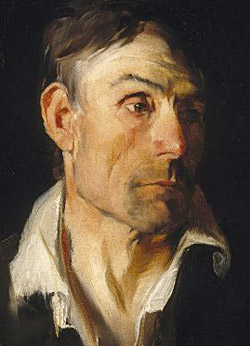 Samen met zijn land- en leeftijdgenoot William Merritt Chase studeerde Frank Duveneck van 1872 tot 1878 aan de kunstacademie in München. De beide jonge Amerikanen stonden daar onder invloed van Wilhelm Leibl en Carl von Piloty en werden gestimuleerd in het rauwe schilderen a la prima zonder retouche. Duveneck en Chase raakten met elkaar bevriend en vertrokken na hun studietijd naar Italiëom in de buitenlucht te schilderen. Terwijl zijn vriend in 1878 terugkeerde naar Amerika, bleef Duveneck die van Duitse afkomst was, in Beieren en begon in het plaatsje Polling les te geven aan een groepje jonge schilders, dat al snel bekend stond als ‘The Duveneck Boys’. In de jaren negentig keerde Duveneck terug naar Amerika en vestigde zich in Cincinnati. Evenals zijn vriend William Merritt Chase in New York werd hij in zijn stad een leidende figuur en introduceerde hij aan de academie het losse a la prima schilderen. In 1904 werd hij directeur van de kunstacademie van Cincinnati.
Henry James, 1875
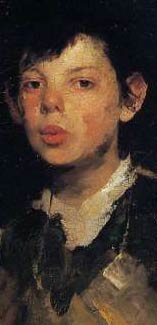 Frank Duveneck (1848-1919), one of the most influential American expatriate realists of the 19th century and the best known of Cincinnati’s painters. (…) During the 1870s and 1880s American artists in Munich experimented with a new style of realism featuring dashing brushwork of quickly applied blocks of color, omitting the careful blending of traditional methods. Young boys or older men from working class neighborhoods were among the artists’ favorite subjects. “Duveneck was uniquely suited to this new style, both because of his precocious skill with the brush and his temperament, which was more suited to brilliantly executing a study of a head in a day than to the careful production of a typical academic piece,” says Denny T. Young.( “He quickly became a leader among the large number of American students drawn to Munich by its exciting new style and often worked with artists such as William Merritt Chase (1849-1916) and John Henry Twachtman (1853-1902), both of whom would earn reputations as major American artists,” she adds.
Typical paintings by Duveneck of this period show a strongly modeled head or figure emerging from a dark, often not fully painted background, with few light or bright highlights. His paint itself is especially oily and has a particularly sumptuous quality. During several summers, Duveneck went to Polling in Bavaria with a group of friends and students to paint en plein air, or out-of-doors. The artist’s landscapes produced there exhibit the free brushstrokes of Duveneck’s figure studies and an immediacy of response to the light and color of the countryside.
In 1879, Duveneck decided to relocate to Florence, Italy, where his student and later wife, Elizabeth Booth, lived. Many of his students, then known as “Duveneck Boys,” followed him to Italy. The artist’s style changed dramatically, with dark street urchins replaced by sweet girls in bright sunlight. With Duveneck‘s broad, vivacious brushstrokes more carefully blended and edited, the paintings of this period lack the masculine force and exuberance of his best work. During the 1890s Duveneck taught a class a the Art Academy of Cincinnati and later became its chairman. From this time the artist’s painting became less important than his legacy as a teacher. He had, however, established himself as an important artist of his period and left a body of work conspicuous for its verve, vitality and quality.
Bron: tfaoi.com
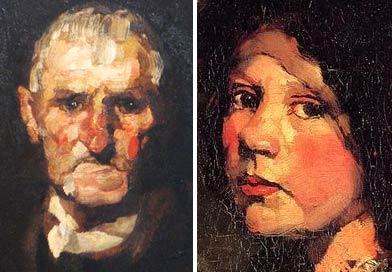
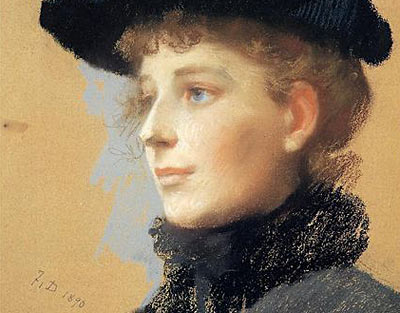
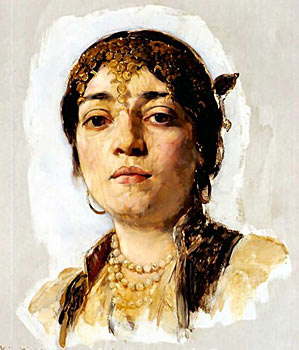
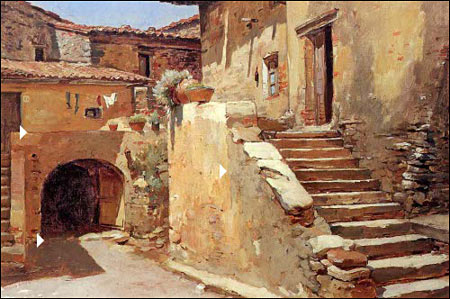
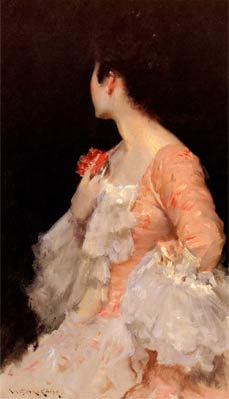 William Merritt Chase was een Amerikaanse schilder die met evenveel bravoure schilderde als zijn landgenoten James Abott MacNeill Whistler of John Singer Sargent. Ook hij werd in Europa gevormd. In hetzelfde jaar (1872) dat John Singer Sargent bij Charles Auguste Emile Durand in Parijs in de leer ging, begon Merritt Chase met zijn studie aan de kunstacademie van München. Deze trok toen net zoveel Amerikaanse studenten als de academie in Parijs. Daar raakte hij onder invloed van de Duitse realist Wilhelm Leibl met wie hij de voorliefde voor het spontane schilderen a la prima deelde. Ook stond hij in deze periode onder invloed van de Belgische schilder
 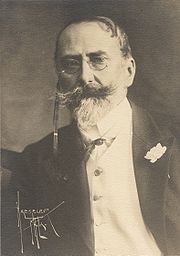 William Merritt Chase (1849-1916) was born at Franklin, Indiana, on the 1st of November 1849. He was a pupil of B. F. Hays at Indianapolis, of J. 0. Eaton in New York, and subsequently of A. Wagner and Piloty in Munich. In New York he established a school of his own, after teaching with success for some years at the Art Students League. A worker in all mediums, oils, water-color, pastel and etching painting with distinction the figure, landscape and still-life, he is perhaps best known by his portraits, his sitters numbering some of the most important men and women of his time. Mr Chase won many honors at home and abroad, became a member of the National Academy of Design, New York, and for ten years was president of the Society of American Artists. Among his important canvases are Ready for the Ride (Union League Club, N.Y.), The Apprentice, Court Jester, and portraits of the painters Whistler and Duveneck, of General Webb and of Peter Cooper.
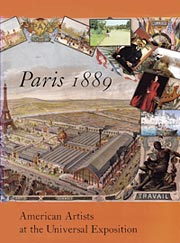 Op de grote wereldtentoonstelling van 1889 in Parijs zond William Merritt Chase acht schilderijen in terwijl de zeven jaar jongere John Singer Sargent er zes liet zien. Daaronder waren de beroemde portretten van The Daughters of Edward D. Boit uit 1882 en van Mrs. Henry White uit 1883. Thomas Eakins (1844-1916) en Thomas Worthington Whittredge (1820-1910) waren andere belangrijke Amerikaanse schilders die op deze expositie vertegenwoordigd waren. William Merritt Chase is op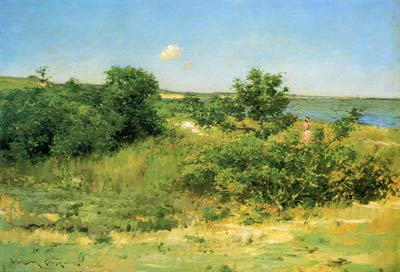
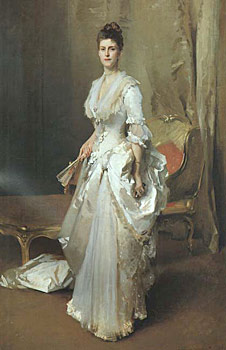 De Amerikaanse schilder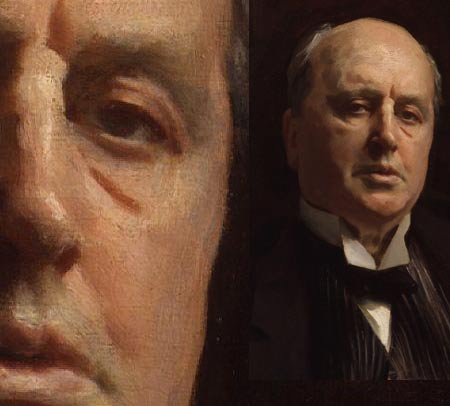
 Hoewel John Singer Sargent (1856-1925) de opkomst van het modernisme nog meemaakte, moest hij er weinig van hebben. Toch was hij zijn eigen tijd soms vooruit. Toen hij in 1884 het portret van Madame X (Madame Pierre Gautreau) schilderde, deed hij dat met zulk een gestroomlijnde eenvoud dat het nu lijkt alsof hij de uitvinder was van de art deco die pas veertig jaar later, aan het eind van zijn leven, in de mode kwam.