een gedigitaliseerde versie van de Gero Codex (969)
is te zien op de site van de Landesbibliothek Darmstadt
is te zien op de site van de Landesbibliothek Darmstadt
Der Gero Codex ist die älteste der mittelalterlichen Handschriften, die der Buchmalerschule des Klosters Reichenau zugeschrieben werden. Sie wurde um das Jahr 969 für den späteren Kölner Erzbischof Gero angefertigt. Die Bilderhandschrift ist ein herausragendes Beispiel der ottonischen Buchmalerei.
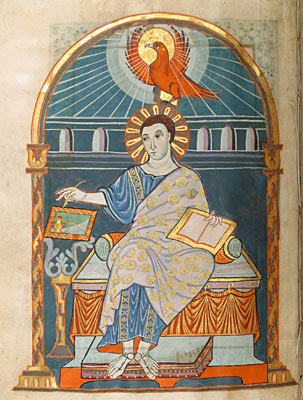
Ottoonse boekverluchtiging
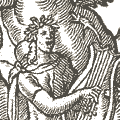
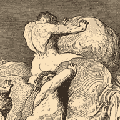
de evangelist Johannes
de evangelist Johannes
Dem Widmungsgedicht nach wurde die Handschrift von einem Mönch Anno für Gero geschrieben, der sie dem Heiligen Petrus für eine diesem geweihte Basilika widmete. Da der Kölner Dom dem heiligen Petrus geweiht ist, erlaubte dieses die Identifikation Geros mit Erzbischof Gero von Köln, der einem bedeutenden Adelsgeschlecht entstammte und damit über die Mittel verfügte, eine solche Prachthandschrift anfertigen zu lassen. Von Köln gelangte die Handschrift in das 1170 gestiftete Prämonstratenserstift Wedinghausen, wo sie bis zur Aufhebung des Klosters im Jahre 1803 aufbewahrt wurde. Der neue Landesherr, Landgraf Ludwig I. von Hessen-Darmstadt, ließ die Handschrift nach Darmstadt überführen. Seit 1948 befindet sie sich im Besitz des Bundeslandes Hessen. Die Handschrift wird heute unter der Signatur Hs. 1948 in der Landesbibliothek Darmstadt aufbewahrt und steht als digitale Faksimileausgabe auf CD einem breiteren Publikum zur Verfügung. Das Original ist aus konservatorischen Gründen nur selten in Ausstellungen zu sehen.
Bron: de.wikipedia.org
Bron: de.wikipedia.org
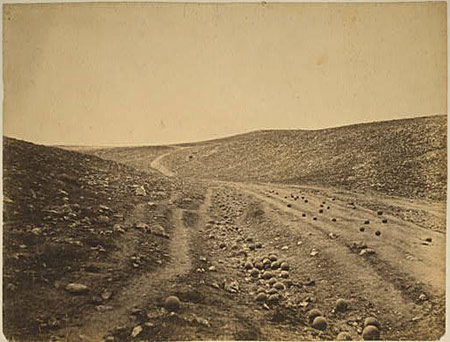
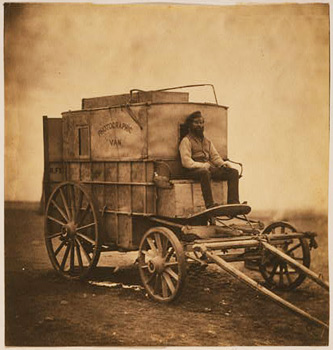
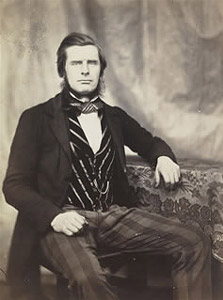 The photographic career of Roger Fenton (1819-1869) lasted only eleven years, but during that time he became the most famous photographer in Britain. Part of the second generation of photographers who came to maturity in the 1850′s, only a decade after the process was invented, Fenton strove to elevate the new medium to the status of a fine art and to establish it as a respected profession. He was the first official photographer to the British Museum and one of the founders of the Photographic Society, later named the Royal Photographic Society, an organization he hoped would help establish the medium’s importance in modern life.