Categorie archief: geschiedenis

Herdenking Slag om Passendale 1917

Koningin Elisabeth II bezocht vandaag de Menenpoort in Ieper
en Tyne Cot Cemetry, de grootste Commonwealthbegraafplaats ter wereld

In mei schreef ik hier iets over mijn bezoek aan Ieper. Vandaag precies negentig jaar geleden begon daar de Derde Slag om Ieper, beter bekend als de Slag om Passendale. Veteranen waren er niet meer bij, maar in Engeland woont nog één 109-jarige (toen dus een knaap van negentien) die het allemaal heeft meegemaakt.

De Britse koningin Elizabeth bracht vanmiddag een bezoek aan de Westhoek. Ze woonde er de herdenking bij van de slag om Passendale, nu negentig jaar geleden. Koningin Elizabeth bracht eerst samen met haar echtgenoot prins Philip en koningin Paola een kort bezoek aan Ieper. Het gezelschap trok naar de Menenpoort waar een speciale Last Post werd geblazen ter gelegenheid van de tachtigste verjaardag van het monument. De vorsten legden er kransen neer en tekenden het gulden boek. De publieke belangstelling voor het bezoek van de Britse vorstin was aan de lage kant, in tegenstelling haar eerdere bezoeken aan de Vredesstad. Volgens cijfers van de lokale politie waren er zo’n zevenhonderd tot duizend kijklustigen komen opdagen.
Menenpoort Ieper
Menenpoort in Ieper
© Leonard Frank
Daarna trok de Britse koningin naar Tyne Cot Cemetery, waar veel Britse soldaten begraven liggen die sneuvelden nabij Passendale. Bij de slag om Passendale in 1917 verloren 500.000 soldaten het leven. De geallieerde troepen boekten er enkele kilometers terreinwinst maar moesten het dorp later weer aan de Duitsers prijsgeven.
 
Bron: standaard.be
Tyne Cot
Tyne Cot Cemetry
langs de weg Zonnebeke-Passendale

Herdenkingen en evenementen Slag om Passendale 1917-2007 | wo1.be

oogcontact

Het portret in de Amerikaanse kunst van de twintigste eeuw
in de Smithsonian National Portrait Gallery

Zoals de meeste Amerikaanse musea is ook het Smithsonian American Art Museum (SAAM) sterk in thematische presentaties op het web. Inmiddels is er een uitgebreid archief ontstaan waarin je eindeloos kunt rondstruinen langs vele presentaties op het gebied van kunst en design, geschiedenis en cultuur en wetenschap en technologie. Uit de vele onderwerpen die onder kunst en cultuur gepresenteerd worden, koos ik de presentatie Eye Contact over het portret in de Amerikaanse kunst van de twintigste eeuw.

The art of portraiture, after thriving for generations at the forefront of the visual arts, rode a roller coaster of reputation in the twentieth century. First it was re-empowered as experimental, then discredited in an age of abstraction, and gradually rediscovered. But although portrait traditions were buffeted by new ways of thinking about art and the individual, artists never completely abandoned the figure; they continued to experiment. These drawings from the National Portrait Gallery’s collections, dating from the 1880s to the 1980s, are adventurous, assertive, witty, or monumental. They all reflect modern themes and aesthetic concerns, confirming the vitality of twentieth-century portraiture.
 
Bron: npg.si.edu
John Steinbeck
John Steinbeck door James Fitzgerald
Fitzgerald shared Steinbeck’s self-reliant approach to artistic creativity, although their friendship was stormy. The two were part of a circle of artists, writers, and intellectuals who gathered around the charismatic figure of marine biologist Edward (“Doc”) Ricketts in Monterey, California. Fitzgerald’s portrait is an attempt to capture the essence of Steinbeck’s personality and creative spirit, rather than a response to a single sitting. The dominant role of the dark pullover and deep shadow over the left side of Steinbeck’s face evoke his famously reclusive persona.
 
Bron: npg.si.edu
Andy Warhol
Andy Warhol door Jamy Wyeth 1976

Eye Contact

summer of love [ 10 ]

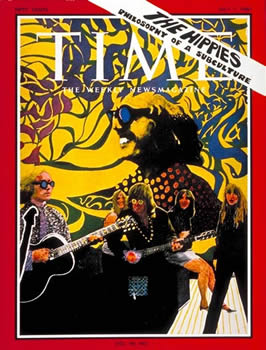
precies 40 jaar geleden probeerde Time de hippieziel te doorgronden
Time 7 July 1967
Time van 7 juli 1967
Last week the hippies were in full flower. In New York City, they brought their tambourines and guitars to the aid of dog owners protesting the leash laws in Greenwich Village’s Washington Square Park, chanting “What is dog spelled backward?” Other New York hippies raised $2,100 for a bail fund to rescue “busted” (arrested) buddies. At California’s Seal Beach, 2,500 devotees gathered for a sunny “love-in” that throbbed to the rhythm of trash-can drums and random flutes. In Dallas, 100 “flower children” gathered in Stone Place Mall, the public hippiedrome, to protest an ordinance that would prohibit gatherings there. A dozen hippies paraded barefoot through the White House, then promised to return for a July 4 “smoke-in” to lobby for legalized marijuana.
 
Elephant Bells. San Francisco’s Haight-Ashbury district – throbbing three-eighths of a far-from-square-mile – is the vibrant epicenter of the hippie movement. Fog sweeps past the gingerbread houses of “The Hashbury,” shrouding the shapes of hirsute, shoeless hippies huddled in doorways, smoking pot, “rapping” (achieving rapport with random talk), or banging beer cans in time to ubiquitous jukebox rhythms. The tinkle of Indian elephant bells echoes from passing “seekers”; along the Panhandle of Golden Gate Park, hollow-cheeked flower children queue up for a plateful of stew, dispensed from the busy buses of the Diggers, a band of hippie do-gooders. Last week the sidewalks and doorways were filling with new arrivals – hippies and would-be hippies with suitcases and sleeping bags, just off the bus and looking for a place to “crash” (sleep). Wise hippies wrap themselves in scrapes against the San Francisco chill, or else wear old Army or Navy foul-weather jackets and sturdy boots. One way to identify the new arrivals is by their mod clothes: carefully tailored corduroy pants, hip-snug military jackets, snap-brimmed hats like those worn by Australian soldiers (also known as Diggers).
 
Bron: coverstory Times Magazine 7 July 1967