Categorie archief: geschiedenis

kruitvat

vandaag 94 jaar geleden:
einde van de Eerste Balkanoorlog op 30 mei 1913

In de eerste Balkanoorlog, die op 17 oktober 1912 was uitgebroken, werden de Turken in vier weken uit Europa gejaagd. Vervolgens waren er 63 diplomatieke ontmoetingen nodig om het vrijgekomen Macedoniëte verdelen en dus nieuwe grenzen op de Balkan vast te stellen. Tenslotte werd op 30 mei 1913 de vrede getekend door de betrokken landen, onder het toeziend oog van de Europese grootmachten. Maar deze vrede was van korte duur omdat Bulgarije zich tekort gedaan voelde ten opzichte van haar buurland Servië.

Griekenland moest daarentegen toezien hoe Bulgarije aan de Egeïsche zee kwam te liggen en op deze strategische plaats dus slavische (indirect Russische!) invloed moest tolereren. De Macedoniërs zelf werd niets gevraagd; ze moesten zich als ‘minderheid’ maar thuis voelen binnen het nieuwe Servië, Bulgarije en Griekenland. Precies een maand later brak alweer een Tweede Balkanoorlog uit, die op 10 augustus 1913 eindigde met een nederlaag voor Bulgarije. Een derde conflict op de Balkan, weer een jaar later, zou heel Europa in brand zetten.
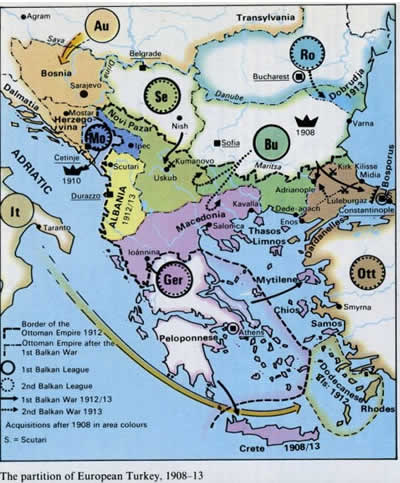
In the spring of 1912, Serbia, Bulgaria, Montenegro and Greece, encouraged by Russia, aligned with the objective of taking control of some or all of the lands still occupied by the Ottoman Empire in Europe. Though the disparate Balkan peoples nursed intense hatreds of one another, they were compelled to join forces and act quickly in order to strike at Turkey – now ensnared in a war with Italy over territory in Libya – in its weakness. On October 8, 1912, Montenegro declared war on Turkey; Serbia, Bulgaria, and Greece followed suit on October 17.
Balkan 1912-1913
Nadat de Turken van Balkan verdreven waren, had het nationalisme helaas de overhand en ging dat ten koste van de eenheid van het orthodox-christendom.
Surprisingly, the Ottoman army was quickly and decisively defeated, as the Balkan forces drove the Turks from almost all of their territory in southeastern Europe over the course of a month. The great powers of Europe – Britain, France, Germany, Austria-Hungary and Russia – scrambled to exert control over the region in the wake of Turkey’s withdrawal, and a congress was convened with representatives of the belligerent nations in London in December 1912 to draw up post-war boundaries in the Balkans. Over the course of the next several months and 63 meetings, as well as renewed hostilities on the battlefield, an agreement was reached, and Macedonia was partitioned between the victors of the First Balkan War. Nevertheless, the peace concluded May 30, 1913, was only tenuous, as Bulgaria felt cheated out of its rightful share by Serbia and Greece.
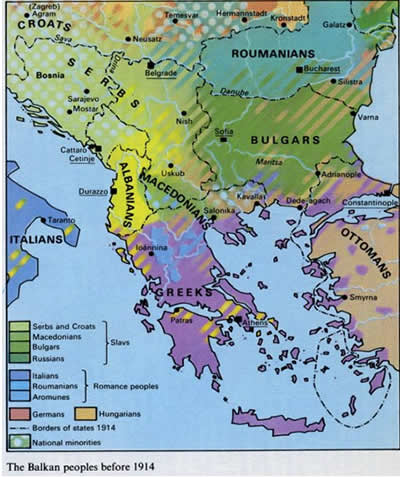
etnische kaart van de Balkan in 1914
Zuid-Oost Europa is een etnische lappendeken en dus een haard voor conflict: welke grens je ook trekt, er ontstaan altijd relevante minderheden.
Exactly a month after the peace treaty was signed, on the night of June 29-30, Bulgaria turned against its former allies, Serbia and Greece, in a surprise attack ordered by King Ferdinand I without consultation with his own government. The attack led to the so-called Second Balkan War, in which Bulgaria was quickly defeated by forces from Serbia, Greece, Turkey and Romania. The Treaty of Bucharest, signed August 10, was negotiated by local states, rather than by the great powers. By its terms, Bulgaria lost a considerable amount of territory and Serbia and Greece received control of most of Macedonia.
 
Bron: history.com

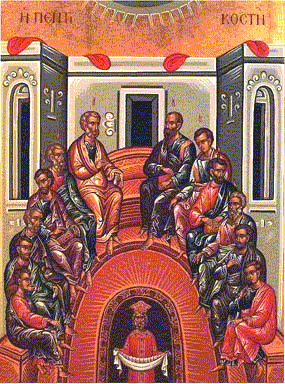
het feest van de Geest

vandaag viert de Kerk haar geboortefeest
In the Church’s annual liturgical cycle, Pentecost is “the last and great day.” It is the celebration by the Church of the coming of the Holy Spirit as the end – the achievement and fulfillment – of the entire history of salvation. For the same reason, however, it is also the celebration of the beginning: it is the “birthday” of the Church as the presence among us of the Holy Spirit, of the new life in Christ, of grace, knowledge, adoption to God and holiness.
pinksteren
pinkstericoon
This double meaning and double joy is revealed to us, first of all, in the very name of the feast. Pentecost in Greek means fifty, and in the sacred biblical symbolism of numbers, the number fifty symbolizes both the fulness of time and that which is beyond time: the Kingdom of God itself. It symbolizes the fulness of time by its first component: 49, which is the fulness of seven (7 x 7): the number of time. And, it symbolizes that which is beyond time by its second component: 49 + 1, this one being the new day, the “day without evening” of God’s eternal Kingdom. With the descent of the Holy Spirit upon Christ’s disciples, the time of salvation, the Divine work of redemption has been completed, the fulness revealed, all gifts bestowed: it belongs to us now to “appropriate” these gifts, to be that which we have become in Christ: participants and citizens of His Kingdom.
 
Bron: ocafs.oca.org

Paradijs

fotos’ van Walter Blum uit de jaren ’50 op Fotofestival Naarden

Na mijn posts over de hel van Passendale, Verdun en Somme even een flinke ruk de andere kant op. Op het Fotofestival Naarden zijn foto’s te zien die Walter Blum in de jaren vijftig maakte. In de jaren na de Tweede Wereldoorlog probeerde men collectief de herinneringen aan de verschrikkingen in roze wolken op te lossen: een babyboom die de blik op de toekomst deed richten en veel mierenzoete plaatjes in tere pasteltinten. Heerlijk om naar te kijken, maar het blijft natuurlijk een bedriegelijke droomwereld. De werkelijkheid had zijn grimmigste gezicht getoond en kon even niet meer verdragen worden.

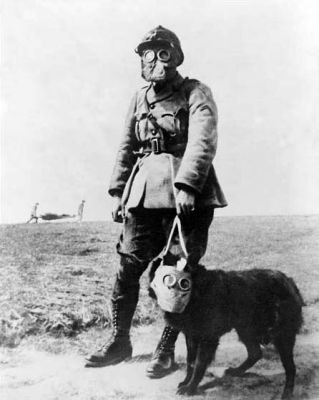
Walter Blum gasmaskers
Walter Blum maakte bewust twee wereldoorlogen mee en koos in de jaren vijftig bewust voor mierenzoete plaatjes. Zijn foto (links) bij het thema Paradijs, staat in maximaal contrast met de foto (rechts) die ik gisteren liet zien: het verschil tussen hemel en hel.
Walter Blum is in 1890 geboren in Berlijn, en overleed in 1964 in Amsterdam. Van oorsprong operazanger in Berlijn. Hij verloor zijn stem en begon met fotograferen. Blum fotografeerde voor een groot aantal mode- en damesbladen in Nederland ondermeer voor Libelle en Eva. Daarnaast fotografeerde hij baby’s, bloemen, honden, katten en paarden. In Naarden bij het thema Paradijs.
 
Bron: fotofestivalnaarden.nl