Categorie archief: 20e eeuw

25 april 1915

Honderd jaar geleden begon de Gallipoli campaign door de ANZAC-troepen
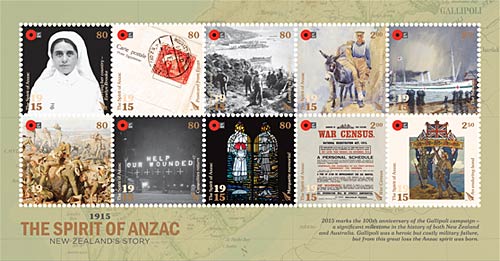
anzac stamps
ANZAC day Australia
More than 8,700 Australians and more than 2,700 New Zealanders lost their lives fighting for King and Empire in this ambitious campaign.
First observed in 1916 and commemorated as an official day of remembrance in 1921, Anzac Day commemorates the landing of the troops at Anzac Cove on 25 April 1915. 100 years on a new generation reflects on the events that occurred at Gallipoli, and remembers all New Zealanders who have served their country during times of conflict and peace.
 
The intention of the Gallipoli campaign was to open the Dardanelles strait to the Allied fleets, giving them access to the Ottoman capital of Constantinople to possibly force a Turkish surrender. After nine months of conflict, the ultimately unsuccessful campaign came to an end and the peninsula remained in its defenders’ hands. The effects the Gallipoli campaign had on New Zealand and Australia were devastating. More than 8,700 Australians and more than 2,700 New Zealanders lost their lives fighting for King and Empire in this ambitious campaign. It was through this hardship that the Anzac spirit was born, a comradeship felt and remembered to this day with the annual observance of Anzac Day – 25 April.
 
The second issue in this special five-year stamp and coin programme, 1915 The Spirit of Anzac tells the story of New Zealand’s role in the First World War. Through the Anzac theme we look at the tale of Evelyn Brooke, a nursing matron from New Plymouth. Evelyn was one of more than 500 nurses from New Zealand who served overseas during the war, and the only New Zealand nurse to be awarded the Royal Red Cross and Bar for her services.
 
Bron: stamps.nzpost.co.nz
anzac stamps
ANZAC day New Zealand

anzaccentenary.gov.au | gallipoli2015.dva.gov.au | Naval operations in the Dardanelles Campaign

22 april 1915

honderd jaar geleden werd bij Ieper voor het eerst gifgas gebruikt
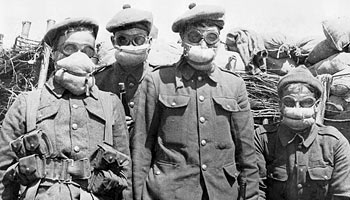
On April 22, 1915, the Germans launched their first and only offensive of the year. Known as the Second Battle of Ypres, the offensive began with the usual artillery bombardment of the enemy’s line. When the shelling died down, the Allied defenders waited for the first wave of German attack troops but instead were thrown into panic when chlorine gas wafted across no-man’s land and down into their trenches. The Germans targeted four miles of the front with the wind-blown poison gas and decimated two divisions of French and Algerian colonial troops. The Allied line was breached, but the Germans, perhaps as shocked as the Allies by the devastating effects of the poison gas, failed to take full advantage, and the Allies held most of their positions.
22 april 1915
Ieper, 22 april 1915
Immediately after the German gas attack at Ypres, France and Britain began developing their own chemical weapons and gas masks.

history.com

A second gas attack, against a Canadian division, on April 24, pushed the Allies further back, and by May they had retreated to the town of Ypres. The Second Battle of Ypres ended on May 25, with insignificant gains for the Germans. The introduction of poison gas, however, would have great significance in World War I.
 
Immediately after the German gas attack at Ypres, France and Britain began developing their own chemical weapons and gas masks. With the Germans taking the lead, an extensive number of projectiles filled with deadly substances polluted the trenches of World War I. Mustard gas, introduced by the Germans in 1917, blistered the skin, eyes, and lungs, and killed thousands. Military strategists defended the use of poison gas by saying it reduced the enemy’s ability to respond and thus saved lives in offensives. In reality, defenses against poison gas usually kept pace with offensive developments, and both sides employed sophisticated gas masks and protective clothing that essentially negated the strategic importance of chemical weapons.
 
Bron: history.com

wereldoorlog1418.nl

21 april 1945

zeventig jaar geleden begonnen de artilleriebeschietingen op Berlijn

Op 21 april 1945 om half tien ‘s morgens, een paar uur na de allerlaatste geallieerde luchtaanval, begon het Rode Leger met een intensief artilleriebombardement op de binnenstad van Berlijn. In de Führerbunker schreeuwde Hitler waar die herrie toch vandaan kwam. Burgdorf antwoordde dat het centrum van Berlijn onder vuur lag van zware Sovjet-artillerie. De Führer trok wit weg. “Zijn de Russen dan al zo dichtbij?” vroeg hij geschokt.

Karstadt
Karstadt am Hermannplatz in de jaren dertig
en na de verwoesting op 25 april 1945

Tijdens de artilleriebombardementen vielen veel slachtoffers. Vanaf 21 april zouden er in tien dagen 1,8 miljoen Russische granaten op het centrum van Berlijn afgevuurd worden. Antony Beevor schrijft in Berlin. The downfall 1945 dat vooral vrouwen het slachtoffer werden van deze beschietingen. Ze stonden vaak urenlang in lange rijen te wachten voor de winkel of de waterpomp, hopend op een “crisisrantsoen”. Op de Hermannplatz vond om half twaalf ‘s morgens een gruwelijk incident plaats: de granaten richtten een verschrikkelijk bloedbad aan onder de Berlijners die voor het warenhuis Karstadt in de rij stonden.

Das Geräusch war anders als alles, was die Berliner bisher gehört hatten – anders als das Pfeifen herabsausender Bomben oder das Belllen der Flak. Die Menschen, die vor dem Kaufhaus Karstadt am Hermannplatz standen, hoben erstaunt die Köpfe und lauschten. Es war ein leises Heulen, irgendwo in der Ferne, doch dann verwandelte es sich in ein gräßliches, schrilles Kreischen. Einen Augenblick lang schienen die Menschen wie hypnotisiert. Dann stoben sie auseinander. Doch es war zu spät. Überall auf dem Platz schlugen Artilleriegranaten ein, die ersten, die die Stadt erreichten. Zerfetzte Leichen schlugen gegen die mit Brettern verschlagenen Schaufenster. Männer und Frauen lagen schreiend auf der Straße und wanden sich vor Schmerzen. Es war Sonnabend, der 21. April, Punkt 11 Uhr 30. Berlin war Frontstadt.
 
Bron: Cornelius Ryan: Der letzte Kampf, blz. 261
Karstadt
Het ultra moderne koopparadijs Karstadt in art deco stijl gebouwd, blaakt van het consumentenvertrouwen. Het werd op 21 juni 1929 geopend en de bomen leken de hemel in te groeien. Vijf maanden later zou de bubble op Wall Street uiteenspatten.

Vier dagen later, op 25 april 1945, gaf Krukenberg het bevel om het gigantische gebouw van Karstadt onmiddellijk op te blazen omdat gevreesd werd dat de Sovjets het binnen afzienbare tijd zouden plunderen.

The decision to blow up Karstadt to prevent it from being taken over and plundered by the Soviets was taken quickly. Civilians who were trying to find food inside the building were all forcefully removed already four days earlier, upon Nordland´s arrival. Krukenberg himself gave a signal to blast the old Karstadt away. Gone were the 70,000 m2 of space, the famous roof gardens, the delivery van lift and the 11-storey towers. Ironically, despite the heavy fighting between what by the end became five (!) Soviet armies and two German divisions, hardly any other buildings around Hermannplatz suffered the same fate.
 
Bron: kreuzberged.com

Karstadt am Hermannsplatz [ berliner-untergrundbahn.de ]
Karstadt am Hermannsplatz [ berlin-hermannplatz.de ]