Categorie archief: Frankrijk

Napoleon en zijn schilders [ 8 ]

Charles Meynier (1763-1832) en Fernand Cormon (1845-1924)
 

Weinig historische figuren zijn zo vaak geschilderd als Napoleon Bonaparte. Niet alleen tijdens zijn bewind maar ook tijdens de Restauratie bleven schilders historische gebeurtenissen vastleggen met Napoleon in het centrum van de aandacht. Tijdens de dictatuur en het Franse keizerrijk (1799-1814) was de ‘fotorealistische’ classicistische stijl de officiële stijl.
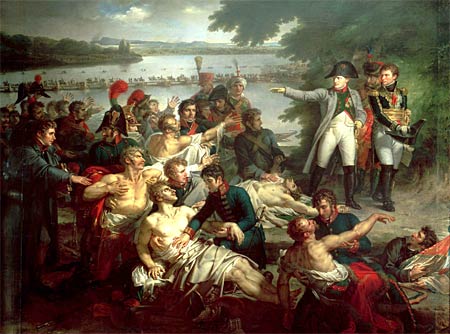
Meynier
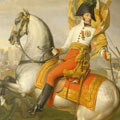
Charles Meynier 1812
Napoleon op het eiland Lobau na de Slag bij Aspern-Essling op 23 mei 1809
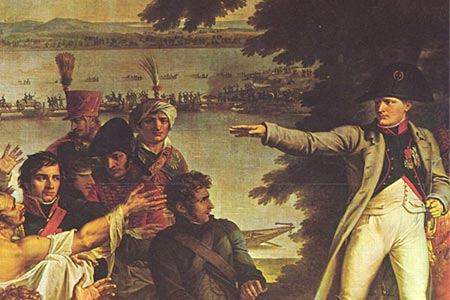
Meynier
detail
The Battle of Aspern-Essling21–22 May 1809
The French lost over 20,000 men including one of Napoleon‘s ablest field commanders and close friend, Marshal Jean Lannes, who died after being mortally wounded by an Austrian cannon ball in an attack on Johann von Klenau’s force at Aspern, which was backed up by 60 well-placed guns. The Austrians had also suffered similar casualties but had secured the first major victory against the French for over a decade. The victory demonstrated the progress the Austrian army had made since the string of catastrophic defeats in 1800 and 1805. The French forces were withdrawn to the island. On the night of the 22nd the last bridge was repaired, and the army awaited the arrival of reinforcements in Lobau. The Austrians failed to capitalise on the situation allowing the French to regroup. One month later, the French made a second attempt to cross the Danube where Napoleon gained a decisive victory over the Austrians at the Battle of Wagram.
 
Bron: en.wikipedia.org
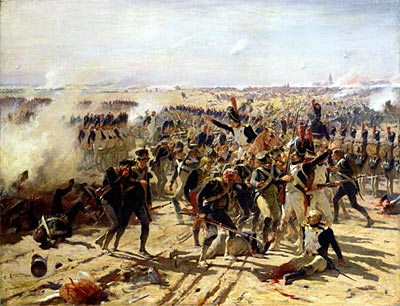
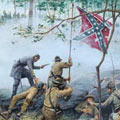
Fernand Cormon
Fernand Cormon
Slag bij Aspern-Essling

Key Painting First Empire [ napoleon.org ] | histoire-image.org
Charles Meynier tentoonstelling [ 2008 ]
Napoleon en zijn schilders [ 7 ]

Louis-François Lejeune (1775-1848)
en Denis Auguste Marie Raffet (1804-1860)
 

Weinig historische figuren zijn zo vaak geschilderd als Napoleon Bonaparte. Niet alleen tijdens zijn bewind maar ook tijdens de Restauratie bleven schilders historische gebeurtenissen vastleggen met Napoleon in het centrum van de aandacht. Tijdens de dictatuur en het Franse keizerrijk (1799-1814) was de ‘fotorealistische’ classicistische stijl de officiële stijl.

Louis-François Lejeune werd opgeleid als schilder op het atelier van Pierre-Henri de Valenciennes. Na de Franse Revolutie meldde hij zich, zoals veel andere jonge kunstenaars, in 1792 aan als vrijwilliger bij de Compagnie des arts de Paris. Hij werd sergeant en nam deel aan de veldtocht naar ons land in de winter van 1794-1795. Na de Slag bij Marengo die hij niet alleen geschilderd heeft, maar waaraan hij ook heeft deelgenomen, werd hij bevorderd tot kapitein. Na de overwinning bij Saragossa in 1808 werd hij tenslotte kolonel.

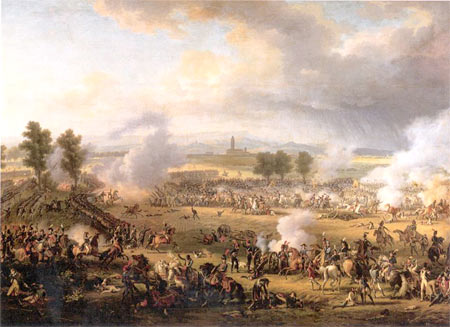
De Slag bij Marengo was een veldslag op 14 juni 1800, tijdens de Tweede Coalitieoorlog. De veldslag vond plaats nabij Alessandria in Piemonte (Noordwest-Italië), tussen Franse troepen (onder bevel van Napoleon Bonaparte) en Oostenrijkse troepen. Hoewel de veldslag ternauwernood door de Fransen werd gewonnen, presenteerde Napoleon de slag als een glorieuze overwinning die de oorlog in het voordeel van Frankrijk besliste. In werkelijkheid was het generaal Moreau die met de Slag bij Hohenlinden op 3 december 1800 de doorslaggevende overwinning op Oostenrijk behaalde.
 
Bron: nl.wikipedia.org
Louis-Francois Lejeune
Louis-François Lejeune 1801
de Slag bij Marengo op 14 juni 1800
The German campaign of 1806 brought Louis-François Lejeune to Munich, where he visited the workshop of Alois Senefelder, the inventor of lithography. Lejeune was fascinated by the possibilities of the new method and whilst there he made the drawing on stone of his famous Cossack (printed by C. and ~f. Senefelder, 1806). Whilst he was taking his dinner, and with his horses harnessed and waiting to take him back to Paris, one hundred proofs were printed, one of which he subsequently submitted to Napoleon. The introduction of lithography into France was greatly due to the efforts of Lejeune.
 
Bron: nl.wikipedia.org
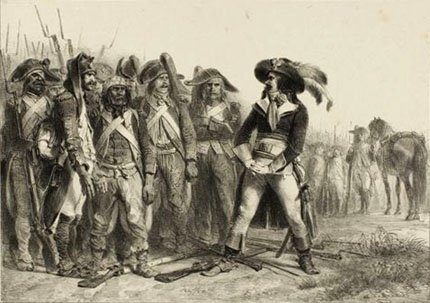
Denis Auguste Marie Raffet
lithografie van Italiaanse soldaten

Denis Auguste Marie Raffet (1804-1860) maakte dankbaar gebruik van de lithografie die door Lejeune in Frankrijk was geïntroduceerd. Tijdens de Restauratie werd hij vooral bekend met zijn litho’s over de Napoleontische veldtochten voor verschillende boeken waaronder de Histoires van Adolphe Thiers.

Key Painting First Empire [ napoleon.org ] | histoire-image.org

Napoleon en zijn schilders [ 6 ]

Anne-Louis Girodet de Roussy-Trioson (1767-1824)
 

Weinig historische figuren zijn zo vaak geschilderd als Napoleon Bonaparte. Niet alleen tijdens zijn bewind maar ook tijdens de Restauratie bleven schilders historische gebeurtenissen vastleggen met Napoleon in het centrum van de aandacht. Tijdens de dictatuur en het Franse keizerrijk (1799-1814) was de ‘fotorealistische’ classicistische stijl de officiële stijl.

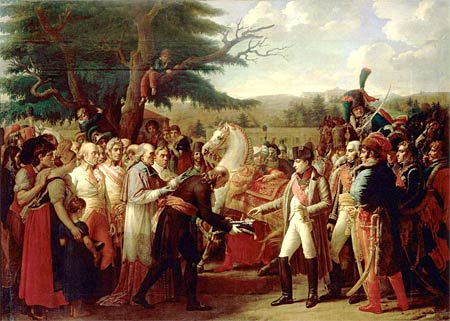
Girodet
Anne-Louis Girodet de Roussy-Trioson
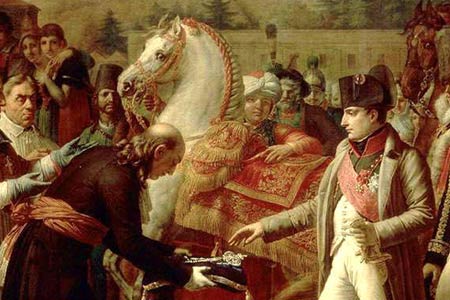
Napoleon ontvangt de sleutel van de stad Wenen bij Schloss Schonbrunn op 13 november 1805
Napoleon receives the keys of Vienna, Schloss Schonbrunn, 13th November 1805. Vienna fell to the French during the War of the Third Coalition. Less than three weeks later the war ended after Napoleon decisively defeated the combined armies of Russia and Austria at the Battle of Austerlitz.
 
Bron: heritage-images.com
Girodet
detail van bovenstaande schilderij

Key Painting First Empire [ napoleon.org ] | histoire-image.org