Categorie archief: boeken

gevallen vrouw

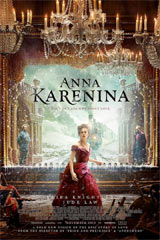
gezien: Anna Karenina (2012)

Anna Karenina 2012Het klassieke verhaal van de vrouw die zich door haar ontrouw te gronde richt, is al vaak verfilmd. De eerste niet zwijgende verfilming is uit 1935 met Greta Garbo in de hoofdrol. De Zweedse sfinx staat misschien wel voor altijd in het geheugen gebeiteld als dé Anna Karenina, met een gezicht dat haar noodlot in de verte reeds ziet opdoemen. Na de Tweede Wereldoorlog volgden verfilmingen met Vivian Leigh (1948), een Russische verfilming uit 1967 met Tatyana Samoylova en een uit 1997 met Sophie Marceau. Daarnaast verschenen een tv-film (1985) en enkele miniseries (2000, 2009 en 2013).

Ondanks al deze filmische interpretaties van Tolstoj’s klassieker, durfde men het in 2012 toch aan opnieuw een grote productie te maken met publiekslieveling Keira Kneightly in de hoofdrol. Je weet van te voren dat ze er beeldig uitziet, maar zou ze ook in staat zijn de diepe tragiek over te brengen van de deugdzame echtgenote die zich toch in het verderf stort door vrijwillig te bezwijken voor Vronski?

Het production design heeft gekozen voor een setting en choreografie a la Moulin Rouge (2001). Het tsaristische Rusland wordt als een theatrale idee gepresenteerd en het verhaal speelt zich af terwijl de decors zichtbaar gewisseld worden. Zoals in de roman speelt ook in deze versie de stoomtrein een belangrijke rol. Het is de metafoor van het noodlot die als een machine genadeloos haar voorbestemde weg gaat en die de hoofdfiguur tenslotte letterlijk verplettert.
het tragische einde van Anna Karenina. Welke actrice geeft beste representatie? Garbo, Leigh, Samoylova of Kneightly?

Anna Karenina [ focusfeatures.com ]

nachtgedachten

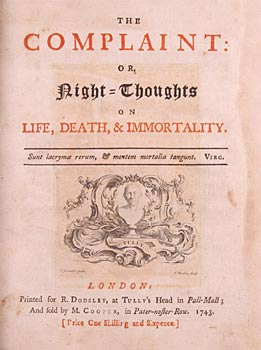
The Complaint or Night Thoughts (1743) van Edward Young

Nog twaalf keer scheuren en Filosofie Scheurkalender is afgescheurd. Maar er ligt alweer een nieuwe klaar. Vandaag een citaat van de Engelse dichter en dominee Edward Young (1683-1765). De Deense filosoof Kierkegaard gebruikte het honderd jaar later als motto voor zijn filosofisch debuut Enten/Eller (1843): Are passions, then, the Pagans of the soul? / Reason alone baptized? alone ordain’d / To touch things sacred?.

Are passions, then, the Pagans of the soul? / Reason alone baptized? alone ordain’d /
To touch things sacred?

Edward Young, The Christian Triumph

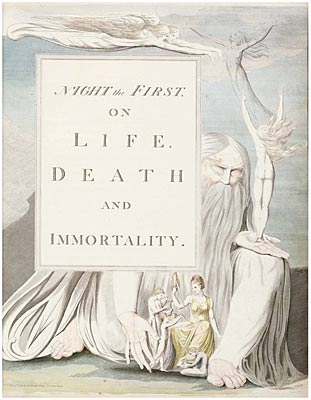
Het citaat komt uit The Christian Triumph, het vierde deel van het lange gedicht The Complaint or Night Thoughts dat uit negen delen bestaat en in 1743 voor het eerst gepubliceerd werd. Het gedicht werd in heel Europa beroemd en had vooral veel invloed op de romantici, die zich afkeerden van het koele verstand en zich overgaven aan de stroomversnellingen van het gevoel. In 1797 verscheen een uitgave die geïllustreerd was door William Blake.

The Complaint
eerste uitgave van The Complaint
or Night Thoughts
(1743)

The Complaint or Night Thoughts
 
1. Life, Death, and Immortality (opgedragen aan Arthur Onslow);
2. Time, Death, Friendship (opgedragen aan Spencer Compton);
3. Narcissa (dedicated to Margaret Bentinck);
4. The Christian Triumph (opgedragen aan Philip Yorke)
5. The Relapse (opgedragen aan George Lee)
6. Glories and Riches (eerste deel van The Infidel Reclaim’d)
7. The Nature, Proof, and Importance of Immortality (tweede deel)
8. Virtue’s Apology of The Man of the World Answered
9. The Consolation (opgedragen aan Thomas Pelham-Holles)

Blake
illustratie van William Blake (1797) bij “Night the First” [ credits: blakearchive.org ]
During the century after its publication in 1742, Night Thoughts was one of the most popular, widely read and influential poems in the English language. However, there have been no editions of the poem since the middle of the nineteenth century. This edition contains a critical introduction setting the poem in the context of the eighteenth-century sublime. There is a commentary which explains historical and linguistic obscurities, and a history of the poem’s publication. The text is based on the first editions of the separate ‘Nights’, and the old spelling has been retained. The editions are collated here, and all substantive variants recorded. Dr Cornford’s critical introduction discusses the conception of the poet’s role; Young‘s attitude to the ‘imagination’ in the context of contemporary epistemology; eighteenth-century attitudes to death and immortality as expressed in sermons and devotional literature; and the critical reception of the poem in Britain and Europe. This discussion seeks to explain why a poem of Christian consolation, orthodox and ancient in its theology, became a seminal work in a secular cult of sepulchral melancholoy.
 
Bron: cambridge.org

het lichaam als machine

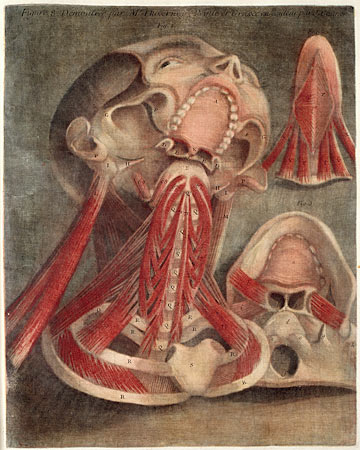
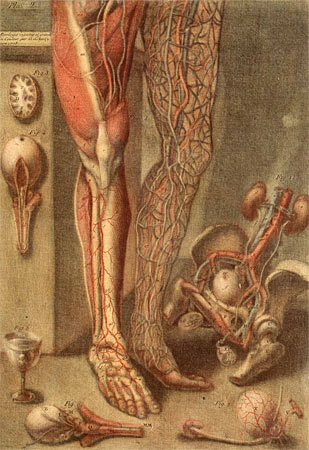
Myologie Complette en Couleur et Grandeur Naturelle (1746)
anatomische prenten van Jacques Fabien Gautier d’Agoty

In 1746 verscheen in Parijs het boekwerk Myologie Complette en Couleur et Grandeur Naturelle met mezzotints van Jacques Fabien Gautier d’Agoty. Lichaamsdelen staan uitgestald als auto-onderdelen. Het komt overeen met de visie van de Franse arts en filosoof Julien Offray de La Mettrie die twee jaar later beroemd zou worden met zijn boek L’homme machine (1748) waarin gesteld wordt dat het menselijk lichaam een machine is.

Gautier d'Agoty
mezzotint uit Myologie Complette en Couleur et Grandeur Naturelle (1746)
D’Agoty was born in Marseille, and became a pupil of the painter and engraver Jacob Christoph Le Blon, with whom he became a rival for title of the invention of a method of an color-printing method based on etching and mezzotint engraving. He later exploited this process with his four sons: it is significant that he published a journal that included color printed images.
 
Gautier d’Agoty was elected a member of the Académie des Sciences, Arts et Belles-Lettres de Dijon, he teamed with the physician and anatomist Guichard Joseph Duverney to produce anatomical albums. Together with his son, Jean-Baptiste André Gautier-Dagoty, they produced a French Gallery and universal gallery of portraits of famous men and women, which only appeared in the first deliveries in 1770 and 1772. D’Agoty died in Paris.
 
Bron: en.wikipedia.org
Gautier d'Agoty
mezzotint uit Myologie Complette en Couleur et Grandeur Naturelle (1746)

Jacques Fabien Gautier d’Agoty (1716–1785) was de vader van de schilder Jean-Baptiste André Gautier-Dagoty (1740-1786) die vooral bekend werd door zijn portret van Marie-Antoinette uit 1775.