Categorie archief: geschiedenis

Psalters [ 4 ]

Oud-Engels: Eadwine Psalter, c. 1150
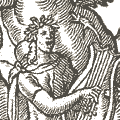
The Eadwine Psalter was produced at Christ Church, Canterbury, around the middle of the twelth century; it is one of several Anglo-Saxon and early Norman books that show the influence of the Carolingian Utrecht Psalter, which was in Canterbury at this time. The psalter is named for the monk Eadwine who was primarily responsible for its production.
 
The book presents three versions of the Psalms: the Gallican version (in the large text block under the picture), the Roman version (to the right of the Gallican), and the Hebrew version (in the rightmost column). The psalter is accompanied by extensive introductions (here the end of one shows above the picture) and commentaries (to the left of the Gallican version). In addition, the Roman version is glossed in Old English and the Hebrew version in Old French.
Eadwine Psalter
bladzijde uit het Eadwine Psalter

Beatus uir qui timet dominum. in mandatis eius cupit nimis.
Potens in terra erit semens eius. generatio

Vertaling
Gelukkig de mens met ontzag voor de Heer en met liefde voor zijn geboden. Zijn nageslacht (geniet aanzien in het hele land, de oprechten worden gezegend.)

meer Psalters

psalters [ 3 ]

Byzantijns: Melisende Psalter, c 1139
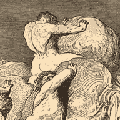
The Melisende Psalter (London, British Library, MS Egerton 1139) is an illuminated manuscript commissioned around 1135 in the crusader Kingdom of Jerusalem, probably by King Fulk for his wife Queen Melisende. It is the most notable example Crusader art, which resulted from a merging of the artistic styles of Roman Catholic Europe and the Eastern Orthodox Byzantine Empire.
 
Seven scribes and illuminators, working in the scriptorium built by the crusaders in the Church of the Holy Sepulchre in Jerusalem, were involved in the creation of the psalter. It measures 21.6 centimetres by 14 centimetres, the size of a psalter for personal rather than liturgical use.
 
Bron: en.wikipedia.org
Melisende Psalter
Deze miniatuur is een directe interpretatie van de traditionele opstandingsicoon: Christus trekt Adam en Eva uit het graf

Queen Melisende’s Psalter | meer Psalters

Psalters [ 2 ]

Iers: Cathach, het Psalter van St. Columba, c. 560-630
Written in Latin. The Cathach is the oldest extant Irish manuscript of the Psalter and the earliest example of Irish writing. It contains a Vulgate version of Psalms XXX (10) to CV (13) with an interpretative rubric or heading before each psalm. It is traditionally ascribed to St. Columba as the copy, made at night in haste by a miraculous light, of a Psalter lent to Columba by St. Finnian. A dispute arose about the ownership of the copy and King Diarmait Mac Cerbhaill gave the judgement “To every cow belongs her calf, therefore to every book belongs its copy”. The arbitration failed and the Psalter of St. Columba passed into the hands of the O’Donnells after the battle of Cul Dremhne in A.D. 561. St. Columba went to Iona in A.D. 563. It is possible to date the manuscript to the late 6th or early 7th century from the script, but modern historical scholarship has cast doubts on the authorship by St. Columba as well as on the dating.
 
Bron: ria.ie.
cathach
detail uit het handschrift

Cathach, the Psalter of St. Columba | meer Psalters