400 jaar geleden ontdekte Hudson het eiland Manhattan
en vandaag ontdekte ik the Mannahatta Project
en vandaag ontdekte ik the Mannahatta Project
Op de website the Mannahatta project reis je 400 jaar terug in de tijd, van de canyons van staal, glas en beton naar het lieflijke, bosrijke eiland dat Mannahatta in 1609 was.
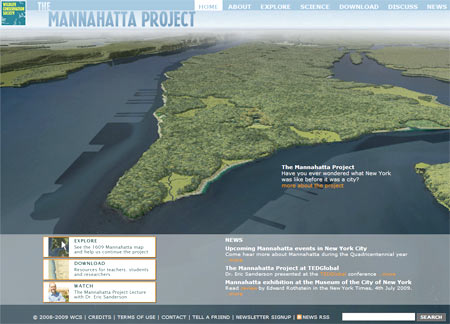
website van the mannahatta project
Now, after nearly a decade of research, the Mannahatta Project at the Wildlife Conservation Society has un-covered the original ecology of Manhattan. That’s right, the center of one of the world’s largest and most built-up cities was once a natural landscape of hills, valleys, forests, fields, freshwater wetlands, salt marshes, beaches, springs, ponds and streams, supporting a rich and abundant community of wildlife and sustaining people for perhaps 5000 years before Europeans arrived on the scene in 1609. It turns out that the concrete jungle of New York City was once a vast deciduous forest, home to bears, wolves, songbirds, and salamanders, with clear, clean waters jumping with fish. In fact, with over 55 different ecological communities, Mannahatta’s biodiversity per acre rivaled that of national parks like Yellowstone, Yosemite and the Great Smoky Mountains!
Bron: themannahattaproject.org
Bron: themannahattaproject.org
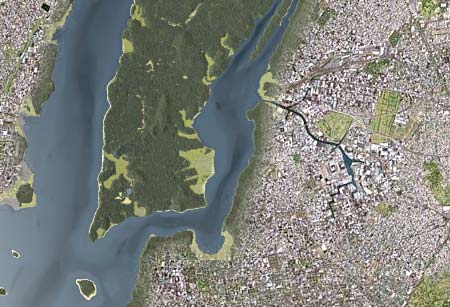
via Google maps kom je op een simulatie van Manhattan in 1609
 Daniel Gerhartz, born in 1965 in Kewaskum, Wisconsin, where he now lives with his wife Jennifer, and their young children, Dan’s interest in art emerged as a teenager. Studies at the American Academy of Art in Chicago, Illinois and his voracious appetite for museums and the modern masters such as