Maandelijks archief: december 2015

nachtgedachten

The Complaint or Night Thoughts (1743) van Edward Young

Nog twaalf keer scheuren en Filosofie Scheurkalender is afgescheurd. Maar er ligt alweer een nieuwe klaar. Vandaag een citaat van de Engelse dichter en dominee Edward Young (1683-1765). De Deense filosoof Kierkegaard gebruikte het honderd jaar later als motto voor zijn filosofisch debuut Enten/Eller (1843): Are passions, then, the Pagans of the soul? / Reason alone baptized? alone ordain’d / To touch things sacred?.

Are passions, then, the Pagans of the soul? / Reason alone baptized? alone ordain’d /
To touch things sacred?

Edward Young, The Christian Triumph

Het citaat komt uit The Christian Triumph, het vierde deel van het lange gedicht The Complaint or Night Thoughts dat uit negen delen bestaat en in 1743 voor het eerst gepubliceerd werd. Het gedicht werd in heel Europa beroemd en had vooral veel invloed op de romantici, die zich afkeerden van het koele verstand en zich overgaven aan de stroomversnellingen van het gevoel. In 1797 verscheen een uitgave die geïllustreerd was door William Blake.
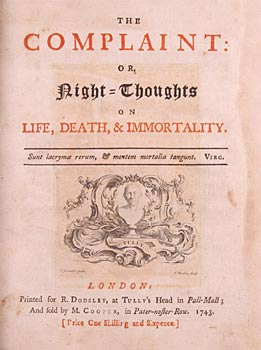
The Complaint
eerste uitgave van The Complaint
or Night Thoughts
(1743)

The Complaint or Night Thoughts
 
1. Life, Death, and Immortality (opgedragen aan Arthur Onslow);
2. Time, Death, Friendship (opgedragen aan Spencer Compton);
3. Narcissa (dedicated to Margaret Bentinck);
4. The Christian Triumph (opgedragen aan Philip Yorke)
5. The Relapse (opgedragen aan George Lee)
6. Glories and Riches (eerste deel van The Infidel Reclaim’d)
7. The Nature, Proof, and Importance of Immortality (tweede deel)
8. Virtue’s Apology of The Man of the World Answered
9. The Consolation (opgedragen aan Thomas Pelham-Holles)
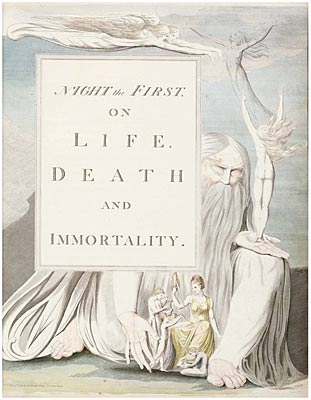
Blake
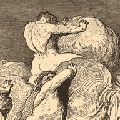
illustratie van William Blake (1797) bij “Night the First” [ credits: blakearchive.org ]
During the century after its publication in 1742, Night Thoughts was one of the most popular, widely read and influential poems in the English language. However, there have been no editions of the poem since the middle of the nineteenth century. This edition contains a critical introduction setting the poem in the context of the eighteenth-century sublime. There is a commentary which explains historical and linguistic obscurities, and a history of the poem’s publication. The text is based on the first editions of the separate ‘Nights’, and the old spelling has been retained. The editions are collated here, and all substantive variants recorded. Dr Cornford’s critical introduction discusses the conception of the poet’s role; Young‘s attitude to the ‘imagination’ in the context of contemporary epistemology; eighteenth-century attitudes to death and immortality as expressed in sermons and devotional literature; and the critical reception of the poem in Britain and Europe. This discussion seeks to explain why a poem of Christian consolation, orthodox and ancient in its theology, became a seminal work in a secular cult of sepulchral melancholoy.
 
Bron: cambridge.org

volg de meester [ 101 ]

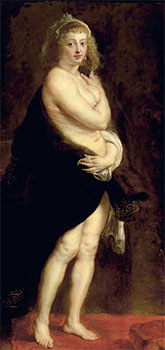
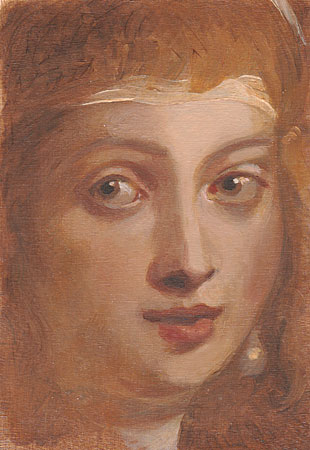
kopie van Hélène Fourment (ca. 1618) door Rubens

het pelskenTot de mooiste schilderijen van Rubens behoort wat mij betreft het portret van zijn tweede vrouw Hélène Fourment (1614-1673), ook wel bekend als het pelsken (1636/38). Rubens schilderde zijn jonge vrouw ten voeten uit in een intieme situatie, in de bad- of slaapkamer. Met een vacht bedekt ze haar schaamte, maar haar open en verwachtingsvolle blik zegt genoeg. Hier smelten twee verliefde blikken samen.
De setting doet mij denken aan de beroemde scene uit Gilda met Rita Hayworth: Gilda are you decent? (Me?!)
Rita spettert na 70 jaar nog steeds van het witte doek. Maar Hélène doet dat al bijna 400 jaar!

Met een vacht bedekt ze haar schaamte, maar haar open en verwachtingsvolle blik zegt genoeg. Hier smelten twee verliefde blikken samen.
Rubens
kopie van portret van Hélène Fourment
(olieverf op geprepareerd papier)

volg de meester [ 1-101 ] | van oude meesters en dingen die niet voorbijgaan

echte winters

Tentoonstelling Echte winters – Het winterlandschap in de 19de eeuw
Teylers Museum Haarlem, 07 november 2015 t/m 06 maart 2016

De meteorologische winter is twee weken oud en vandaag en morgen kan het kwik in Nederland stijgen tot 14 graden. Dat is ver boven het gemiddelde. Als het zo blijft moet voor de kerst het gras gemaaid worden. De échte winter lijkt tot het verleden te behoren. Deze winter is in Haarlem in het Teylers Museum de tentoonstelling Echte winters te zien.

echte winters
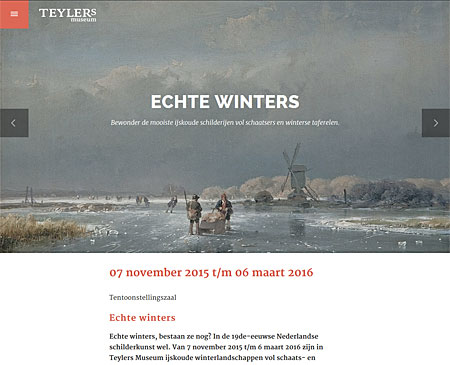
website van het Teylers Museum
Echte winters, bestaan ze nog? In de 19de-eeuwse Nederlandse schilderkunst wel. Van 7 november 2015 t/m 6 maart 2016 zijn in Teylers Museum ijskoude winterlandschappen vol schaats- en sleeplezier te zien van specialisten als Schelfhout en Apol, naast werk van beroemde schilders als Koekkoek, Jongkind, Mauve, Breitner en Van Gogh. Echte winters laat het 19de-eeuwse winterlandschap voor het eerst in zijn volle breedte zien, van knusse koek en zopies op een stadsgracht tot heftige taferelen met rampzalig kruiend ijs.
 
Bron: teylersmuseum.nl
echte winters
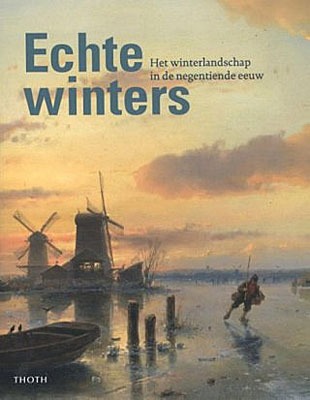
Bij de tentoonstelling Echte winters verschijnt een boek. Het winterlandschap in de 19de eeuw, uitgegeven door THOTH. Het boek kost 17,90 en is te koop in de museumwinkel.

Tentoonstelling: Echte winters [ teylersmuseum.nl ] | Boek: Echte winters [ thoth.nl ]