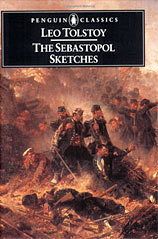
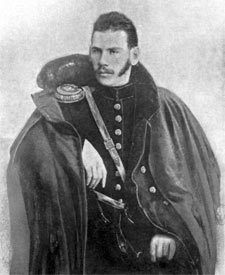
 Tijdens de belegering van Sebastopol (1854-1855) schreef Leo Tolstoi (1828-1910) drie impressies over Sebastopol (december, mei en augustus) die gebundeld werden in Севастопольские рассказы. Een Engelse vertaling (The Sebastopol Sketches) is in de serie penguin classics al zeker dertig jaar verkrijgbaar. Een Nederlandse vertaling heb ik nog niet kunnen vinden. Tolstoi was als 26-jarige als commandant van een artilleriebatterij eerst in Silistra en daarna in Sebastopol gelegerd. Door zijn frontervaring tijdens de Krimoorlog kon hij in Oorlog en Vrede zo levendig de historische veldslagen bij Austerlitz en Borodino beschrijven. Orlando Figes begint het achtste hoofdstuk van zijn boek over de Krimoorlog met de impressie uit Sebastopol in December
 Toward the north the activity of the day begins gradually to replace the nocturnal quiet; here the relief guard has passed clanking their arms, there the doctor is already hastening to the hospital, further on the soldier has crept out of his earth hut and is washing his sunburnt face in ice-encrusted water, and, turning towards the crimsoning east, crosses himself quickly as he prays to God; here a tall and heavy camel-wagon has dragged creaking to the cemetery, to bury the bloody dead, with whom it is laden nearly to the top. You go to the wharf—a peculiar odor of coal, manure, dampness, and of beef strikes you; thousands of objects of all sorts—wood, meat, gabions, flour, iron, and so forth—lie in heaps about the wharf; soldiers of various regiments, with knapsacks and muskets, without knapsacks and without muskets, throng thither, smoke, quarrel, drag weights aboard the steamer which lies smoking beside the quay; unattached two-oared boats, filled with all sorts of people,—soldiers, sailors, merchants, women,—land at and leave the wharf.
Bron: online-literature.com
Sebastopol in December 1854
Sebastopol in May 1855
Sebastopol in August 1855
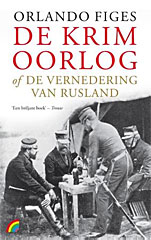 Orlando Figes heeft een derde van zijn boek nodig om de aanloop naar de Krimoorlog te beschrijven. Met het
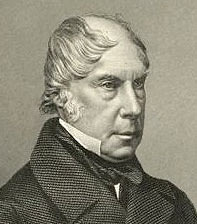 In maart 1854 verklaarde Groot-Brittannië de oorlog aan Rusland en werd zo betrokken bij de Krimoorlog. Aberdeen bleek niet goed in staat te zijn om met de oorlogsvoering om te gaan en sommige regeringsleden vonden de oorlogsvoering niet agressief genoeg. In januari 1855 diende parlementslid John Arthur Roebuck een motie in waarin hij voorstelde om een onderzoekscommissie op te richten die de manier van oorlogsvoering van Aberdeen moest controleren. Het voorstel van Roebuck werd door het parlement aangenomen en Aberdeen beschouwde dit als een motie van wantrouwen, waarna hij ontslag nam als premier.