vandaag wordt in de Tour de France de Tourmalet beklommen

Le Tourmalet
letour.fr | de legende van de Tourmalet | overzicht etappes 2008
letour.fr | de legende van de Tourmalet | overzicht etappes 2008
Filosofen worden door politici meestal ingezet om de eigen politiek te bevestigen of te rechtvaardigen. Favouriete filosofen van politici zijn daarom in de regel politieke denkers. Ook de Amerikaanse denker Reinhold Niebuhr (1892-1971) hield zich zijn hele leven met politiek bezig. Zowel Obama en McCain beschouwen hem als hun favouriete filosoof, las ik gisteren in Filosofie Magazine. Centraal staat bij Niebuhr de vraag hoe je het (christelijke) geloof kunt combineren met je politieke overtuiging. In Amerika is dat een actuele vraag bij het electoraat. Het kwaad moet bestreden worden maar dat rechtvaardigt geen politiek van het stichten van het Koninkrijk God’s op aarde onder de vlag van de eigen natie. Niebuhr zou zich daarom ook verzet hebben tegen de War on Terrorism van George W.Bush.
Reinhold Niebuhr (1892-1971)
Reinhold Niebuhr was read widely by Christian leaders in the postwar years. Among the most famous was the Rev. Martin Luther King, Jr., who gave credit to his influence. Niebuhr was one of the major thinkers who contributed to the evolving postwar American national identity. His work inspired an American psyche that evoked a mythological worker of justice in the world notion that he stressed was a vision of what might be, not a description of America at the time. Niebuhr saw America as moving in the direction of justice, despite failures of racial equality and foreign policy in Vietnam. Writing about class equality, he said “We have attained a certain equilibrium in economic society by setting organized power against organized power”. Niebuhr was also the author of many aphorisms.
Despite the accolades Niebuhr received during his lifetime, after his death his politics and theology fell sharply out of favor among many mainline Protestants. Liberation theology, with its radical Marxist aims and roots in concrete struggles of the oppressed, became a more dominant paradigm, in seminaries if not in pulpits. Others turned to a “postliberalism,” a theological neo-conservatism roughly aligned with Karl Barth’s version of neo-orthodoxy. Still others, reacting negatively to the pessimism and supposed militarism which Niebuhr’s thought seemed to endorse, returned to liberalism, beginning with the “Death of God” movement in the mid-1960s. In the later 20th century, the increasingly active conservative evangelicals in the U.S. did not much address Niebuhr’s thought, probably in common with the majority of the church-going public.
Bron: en.wikipedia.org
 In de voetsporen van Heidegger
 Voetnoten bij de 19e eeuw
 Amerikaanse Burgeroorlog
 Napoleon en zijn schilders
 Landschapsschilders uit de Goethezeit
 Schilders in Italië
 De schilder en zijn broodheer
 De waakzaamheid van het hart
 Ovidius’ Metamorphosen
 Dantes Divina Commedia
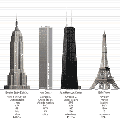 Wolkenkrabbers
 Op zoek naar de atoomstijl
 Een avontuur van luitenant Blueberry
 My favourite things