laat-negentiende eeuwse portretschilders
Joaquin Sorolla y Bastida (1863-1923)
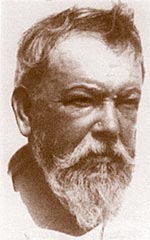 Rond 1900 werd Joaquin Sorolla y Bastida de grootste Spaanse schilder sinds Velasquez (en volgens sommigen sinds Goya) genoemd. Maar in de twintigste eeuw zou zijn naam volledig verdrongen worden door die van Picasso en Dali. Vóór afgelopen woensdag had ik zelfs nog nooit van hem gehoord! Sorolla was in de eerste plaats geen portretschilder, maar mag toch niet ontbreken in het rijtje met virtuoze laat-negentiende eeuwse portretschilders. Anders dan John Singer Sargent, Anders Zorn of Giovanni Boldini schilderde hij niet zozeer portretten van de rijken der aarde, maar was hij vooral geïnteresseerd in taferelen uit het dagelijks leven, bij voorkeur het leven aan het strand van Valencia, de stad waar hij voor altijd mee verbonden blijft. Je kunt hem enigszins vergelijken met zijn tijdgenoot Israëls, Isaac Israëls welteverstaan. Want ook al deelde vader Jozef Israels zijn belangstelling voor het vissersleven, zijn bruine palet deelde hij niet met zoon Isaac en Sorolla. De jongere generatie voelde zich juist aangetrokken tot het stralende impressionistische palet. Maar in zijn beginperiode werd Sorolla nog wéll beïnvloed door de oude meesters die hij in het Prado bestudeerde en werkte hij in een bruine grondtoon. De onderstaande tronies zijn daar een voorbeeld van. Ze roepen onmiddellijk het realisme van Velazques en Murillo in de herinnering.
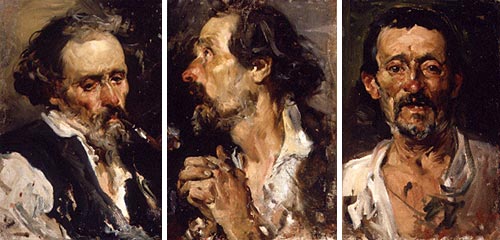
tres cabezas de estudio
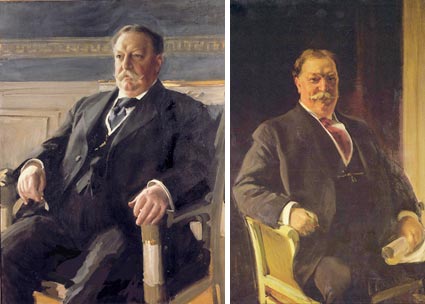
Op zijn veertigste was Sorolla in 1903 in Europa een beroemdheid. Ook in Amerika lag zijn werk goed. In 1909 viel hem de eer te beurt een portret van president Howard Taft te schilderen. Blijkbaar kon de Spanjaard goed met hem opschieten, want vergeleken met het portret dat de Zweedse schilder Anders Zorn van de president schilderde, komt Howard Taft in zijn portret geanimeerd naar voren. Desalnietemin werd Zorn‘s portret het officiële staatsportret. Overigens raakten Sorolla en Zorn goed met elkaar bevriend. Ook met de Amerikaanse schilder John Singer Sargent kon hij het goed vinden. Volgend jaar is er in het National Academy Museum in New York een tentoonstelling over deze drie schilders: A mirroring of riches: Anders Zorn, John Singer Sargent, and Joaquin Sorolla Y Bastida in America.
President Howard Taft geportretteerd door Anders Zorn (links) en Joaquin Sorolla (rechts) Dat van Zorn werd het officiële portret.
A mirroring of riches: Anders Zorn, John Singer Sargent, and Joaquin Sorolla Y Bastida in America
National Academy Museum New York, 18 februari 2010 – 2 mei 2010
This exhibition (including approximately 45-50 paintings) will primarily focuses attention on portraits of Americans by
Zorn and
Sargent, and reveal the extraordinary works these European-based artists created during the course of their many visits to the United States from approximately 1890-1915. This will be complemented with a smaller group of paintings by
Sorolla, drawn primarily from the collection of
The Hispanic Society of America. The Spanish artist visited America in 1909 and 1911, and during the early years of the 20th became enormously popular in the United States as a painter of beach scenes. Like
Zorn and
Sargent, he was also avidly sought after as a portraitist by patrons of great wealth, power, and influence.
A Mirroring of Riches will also include a group of closely related outdoor pictures by
Zorn, Sargent and Sorolla.
Bron:
artmagick.com
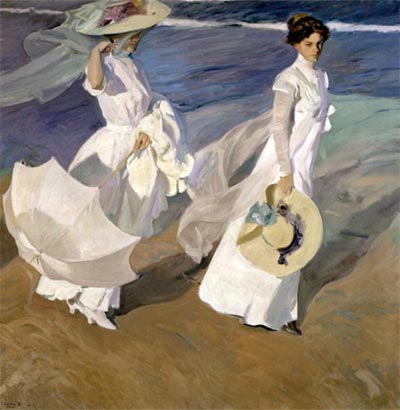
wandeling langs het strand 1909
een van zijn bekendste werken dat wat compositie en esthetische intelligentie betreft dicht in de buurt komt van een reisaffiche uit het eerste kwart van de twintigste eeuw. Schilders als Sorolla, Boldini en Singer Sargent hadden veel invloed op het affiche en de reclameschilderkunst.
Maar het hoofdthema van Sorolla was dus niet het portret maar het alledaagse leven. Dat schilderde hij met een impressionistisch palet, maar legde daarbij veel meer de nadruk op de ruimtelijkheid en de geslotenheid van de vorm dan in het impressionisme. In hetzelfde jaar waarin hij president Howard Taft schilderde, had hij een grote tentoonstelling in New York die was georganiseerd door The Hispanic Society of Amerika. Sorolla bleef tijdens deze tentoonstelling (waar hij 195 schilderijen verkocht!) vijf maanden in Amerika en schilderde twintig portretten van vooraanstaande Amerikanen waaronder dus ook de president. In 1911 ging hij voor een tweede keer naar de Verenigde Staten en exposeerde hij ditmaal in het Art Institute van Chicago 161 nieuwe schilderijen. Aansluitend begon hij aan zijn magnum opus The Provinces of Spain in opdracht van de The Hispanic Society of Amerika. Hij schilderde veertien grote doeken waarop hij de provincies van Spanje portretteerde: Navarre, Aragon, Catalonia, Valencia, Elche, Seville, Andalusia, Extremadura, Galicia, Guipuzcoa, Castile, Leon en Ayamonte. Deze titanenklus zou hem uiteindelijk zijn leven kosten. In 1920 werd hij getroffen door een hersenbloeding en bleef drie jaar lang tot aan zijn dood verlamd. Sorolla zou volledig overschaduwd worden door Picasso en Dali en uit de kanon van de twintigste eeuw verdwijnen. De laat-negentiende eeuwse virtuozen kregen na 1910 zonder uitzondering hun tijd tegen. Het modernisme heeft hun bijna doen vergeten. In de officiële kanon zul je de namen Zorn, Singer Sargent, Boldini, Sorolla, Chase en Duveneck niet tegenkomen. Maar voor mij is hun werk niet minder de moeite waard dan dat van hun tijdgenoten, de moderne klassieken Cezanne, Van Gogh, Matisse, Picasso, Mondriaan en Kandinsky.
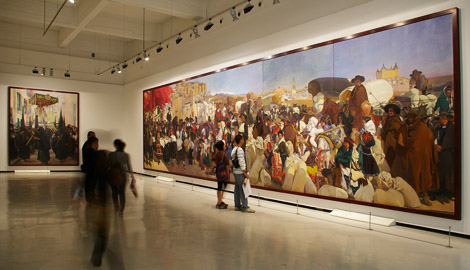
deel van Vision of Spain 1911-1919
de opdracht die Sorolla zijn leven kostte
Overigens zijn de veertien grote doeken van van The Provinces of Spain bezig met een rondreis door Spanje (Valencia, Sevilla, Malaga, Barcelona, Bilbao en Madrid) en keren eind 2009 weer terug naar Amerika.
Visions of Spain in 2009 op tournee in Spanje
The Collection
Visions of Spain by
Joaquin Sorolla which gathers 14 great canvases which the Hispanic Society of America commissioned to the artist at the beginning of the 20th Century opened today in Malaga where it can be viewed until September 21. This exhibit will return to the U.S. at the end of 2009; it has passes through Valencia, Seville and after Malaga it will travel to Barcelona, Bilbao and Madrid.
Bron:
barnsitegallery.com
Joaquín Sorolla was the eldest child born to a tradesman, also named Joaquín, and his wife, Concepción Bastida. His sister, Concha, was born a year later. In August 1865 both children were orphaned when their parents died, possibly from cholera. They were thereafter cared for by their maternal aunt and uncle. He received his initial art education, at the age of fourteen, in his native town, and then under a succession of teachers including Cayetano Capuz, Salustiano Asenjo. At the age of eighteen he traveled to Madrid, vigorously studying master paintings in the Museo del Prado. After completing his military service, at twenty-two Sorolla obtained a grant which enabled a four year term to study painting in Rome, Italy, where he was welcomed by and found stability in the example of F. Pradilla, the director of the Spanish Academy in Rome. A long sojourn to Paris in 1885 provided his first exposure to modern painting; of special influence were exhibitions of Jules Bastien-Lepage and Adolf von Menzel. Back in Rome he studied with José Benlliure, Emilio Sala, and José Villegas.
Bron: en.wikipedia.org
Op artrenewal.org staan 83 schilderijen van Sorolla
meer virtuoze streken | joaquin-sorolla-y-bastida.org | museosorolla.mcu.es
 The Academic tradition, as I have already pointed out, was principally concerned with the planned picture. All the academic devices of underpainting, color theory, composition, anatomy, drawing from nude models and painting from these drawings, historical research in costume, literary research in the classics, and so on, which are still taught at the Academie des Beaux Arts in Paris, had as their sole end the production of a planned picture with a subject. Even today in Paris, a student competing for the Prix de Rome in painting, is shut up ‘en loge’, in a studio with a bed, food, paints,canvas, access to books and models, and a subject (Ceasar on the Rubicon, Achilles in His Trent, The death of Cleopatra) and is expected to paint without help and in a given time a picture by which his merits as a painter can be judged. Since the acadmic devices were designed precisely for turning out these elaborately planned pictures with a subject, the planned picture could lend itself all to easily to anecdote and official poetry. And this, of course, it did. It is perhaps not the fault of the academies that official poetry of the nineteenth century went bad. But the academies did very little to prevent it. Even when such magnificent painters as David and Ingres were at the head of the Beaux Arts, the official poetry the Academy and the salon endorsed was none too good (like the official poetry of Napoleon’s coronation both of these painters illustrated).