Giovanni Boldini 1842-1931
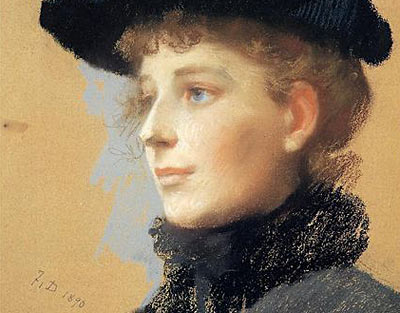
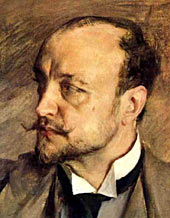 Giovanni Boldini‘s vader was een schilder van religieuze onderwerpen en liet zijn zoon studeren aan de kunstacademie in Florence. In 1872 vertrok Boldini naar Parijs om daar zijn eigen stijl te ontwikkelen. Hij raakte bevriend met James Abbot MacNeill Whistler en met Edgar Degas. In deze periode tonen zijn portretten verwantschap met de portretten van John Singer Sargent maar ook komt hij in Frankrijk onder invloed van het impressionisme. Toen hij het bekende portret van Giuseppi Verdi (1886) schilderde, had Boldini zijn naam als portretschilder al gevestigd. Maar zijn glorietijd begon pas echt toen hij zich in de jaren negentig in Londen gevestigd had. De Master of Swish werd in ‘the Gay Nineties‘ een beroemdheid. Maar later was Giovanni Boldini net als John Singer Sargent en Anders Leonard Zorn een van de vele laat-negentiende eeuwse schilders die door de komst van het modernisme aan het eind van hun leven uit de gratie raakten.
In 1897, Boldini was engaged, through a mutual friend, Madame Veil-Picard, to paint the portrait of Count Robert de Montesquiou. The painter could not fail to be attracted to the personality of this man of letters, the archetypal, contemporary aesthete and new incarnation of the Baudelarian dandy.
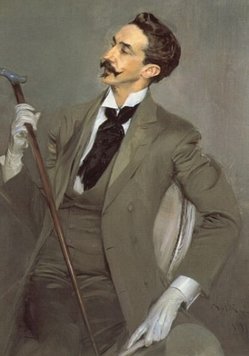
Deze dandy was een bewonderaar van Singer Sargent’s portret van Madame X uit 1884. Boldini portretteert hem net als Madame X en profile
In this painting, the artist is not content with highlighting Montesquiou’s aristocratic elegance, nonchalance and refinement. He holds a cane like a sceptre, transforming it into a symbol of royalty. Boldini appears to be illustrating the first verse from one of Montesquiou‘s poems in his volume Chauve Souris: “I am the sovereign of transitory things”. By putting together a pose taken from the great tradition of 16th and 17th century portraits with an image of modernity, was Boldini wishing to introduce a little irony in regard to Montesquiou’s fanatical aestheticism? This is how many commentators at the time interpreted this portrait.
Bron: musee-orsay.fr
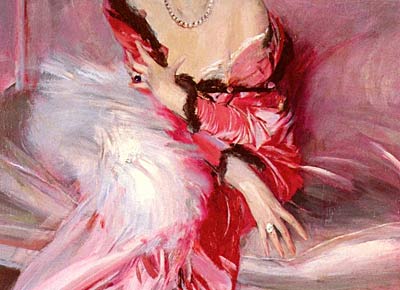
Het snelle gebaar werd bij Boldini tenslotte een maniertje. Reclameschilders konden deze vlugge manier van werken dankbaar in hun commerciële werk toepassen.
(Time Magazine, April 3, 1933, p. 28-29)
With her tongue ever so slightly in her check, Mrs. Chester Dale, collector and authority on French painting, helped organize four months ago an exhibition of the paintings of the late Alphonse Bouguereau, barroom decorator par excellence of the Gay Nineties. For all their technical slickness, the correct perspective for looking at a Bouguereau nude was always obtained through the bottom of a 16 oz. Beer glass. Critics in the chill light of a formal art gallery were not impressed with the “Back to Bouguereau“ movement. Last week with a better artist and in a better cause (a loan exhibition at the Wildenstein Galleries for New York’s Child Welfare Committee), Maud Dale revived the work of one of M. Bouguereau’s contemporaries, the late Giovanni Boldini.
Giovanni Boldini (“Zanin“ to intimates) was a society portraitist as artificial as any who ever stretched a lady’s fingers to tickle her vanity. Modernists excuse Zanin Boldini for a virtue denied most Academicians, an exuberance, vivacity and frank sensuousness that won him the title of “Master of Swish,“ and made his huge canvases on view last week a series of gay explosions, brilliantly painted.
(…)
The passing of the petticoat was the passing of Boldini’s art. He lived to be 88. Too purblind to paint, he could still drink champagne and chuck pretty young models under the chin. In 1929, aged 86, he suddenly married. At his wedding breakfast he made a little speech: “It is not my fault if I am so old, it’s something which has happened to me all at once.“
Bron:jssgallery.org
Op artrenewal.org staan 57 schilderijen van Giovanni Boldini

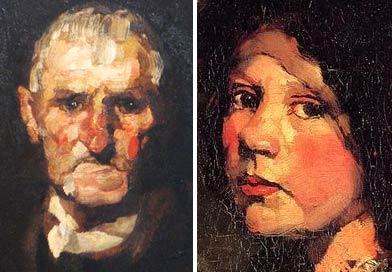
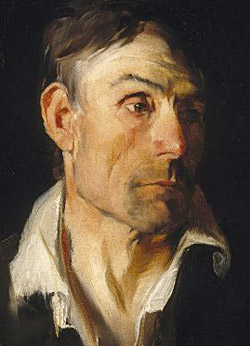 Samen met zijn land- en leeftijdgenoot William Merritt Chase studeerde Frank Duveneck van 1872 tot 1878 aan de kunstacademie in München. De beide jonge Amerikanen stonden daar onder invloed van Wilhelm Leibl en Carl von Piloty en werden gestimuleerd in het rauwe schilderen a la prima zonder retouche. Duveneck en Chase raakten met elkaar bevriend en vertrokken na hun studietijd naar Italiëom in de buitenlucht te schilderen. Terwijl zijn vriend in 1878 terugkeerde naar Amerika, bleef Duveneck die van Duitse afkomst was, in Beieren en begon in het plaatsje Polling les te geven aan een groepje jonge schilders, dat al snel bekend stond als ‘The Duveneck Boys’. In de jaren negentig keerde Duveneck terug naar Amerika en vestigde zich in Cincinnati. Evenals zijn vriend William Merritt Chase in New York werd hij in zijn stad een leidende figuur en introduceerde hij aan de academie het losse a la prima schilderen. In 1904 werd hij directeur van de kunstacademie van Cincinnati.
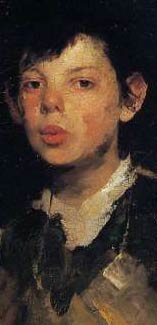 Frank Duveneck (1848-1919), one of the most influential American expatriate realists of the 19th century and the best known of Cincinnati’s painters. (…) During the 1870s and 1880s American artists in Munich experimented with a new style of realism featuring dashing brushwork of quickly applied blocks of color, omitting the careful blending of traditional methods. Young boys or older men from working class neighborhoods were among the artists’ favorite subjects. “Duveneck was uniquely suited to this new style, both because of his precocious skill with the brush and his temperament, which was more suited to brilliantly executing a study of a head in a day than to the careful production of a typical academic piece,” says Denny T. Young.( “He quickly became a leader among the large number of American students drawn to Munich by its exciting new style and often worked with artists such as William Merritt Chase (1849-1916) and John Henry Twachtman (1853-1902), both of whom would earn reputations as major American artists,” she adds.