Maandelijks archief: december 2006

Tishe !

Tishe! van Victor Kossakovsky op IDFA-Festival
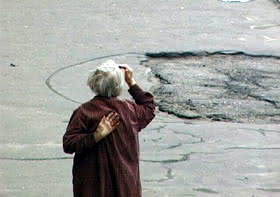
Tishe!De Russische regisseur Victor Kossakovsky maakte een documentaire over zijn straat. Een jaar lang stond zijn camera achter het raam. Een scenario had hij niet. ‘Ik wil niets vertellen of doceren. Ik wil wat laten zien.’
Voordat hij Tishe! begon te filmen wist Victor Kossakovsky niet wat hij wilde vertellen. Ook tijdens de opnamen brak hij zich daar het hoofd niet over. ‘Als ik al weet wat ik wil zeggen, waarom zou ik het dan nog doen? Als ik film, wil ik niet weten wat ik ga doen. Misschien draai ik de camera naar links. Misschien draai ik hem wel naar rechts.’
 
Vanuit het open raam van zijn appartement in hartje Sint Petersburg, op de eerste verdieping aan een doorgaande weg, filmde Kossakovsky – in 1993 met Belovy winnaar van de Joris Ivens Award – alles wat hem opviel met een digitale camera. Na een jaar had hij tien uur materiaal. ‘Elk shot was prachtig. Maar mensen houden niet van films die tien uur duren. Ik heb dus achtenhalf uur moeten weggooien.’
 
Bron: cinema.nl

interview met Victor Kossakovsky | Alles is toevallig

schilderachtige klassenstrijd

Deze dagen kijk ik naar Novecento (1976) op DVD

Vorige maand was ik onder de indruk van La Meglio Gioventu, een Italiaanse familiekroniek die zich afspeelt tussen 1966 en de tegenwoordige tijd. Het riep bij mij de herinneringen op aan het epos Novecento dat ik een jaar of twintig geleden voor het laatst zag. Anders dan La Meglio Gioventu is Novecento typisch Italiaanse cinema met veel schilderachtige fotografie. De cinematografie is die van het brede gebaar, dus met veel pans. Ook al is de landstreek waar de film zich afspeelt van een indrukwekkende saaiheid (een dijk langs rijen aangeplante bomen), door de atmosferische opnamen krijgt het iets verhevens en tijdloos. Eigenlijk wel jammer dat de film in het engels is opgenomen.

novecento
socialisme en fascisme hadden in de vorm veel met elkaar gemeen: het waren ideologieën voor het volk, met vlaggen en strijdliederen.

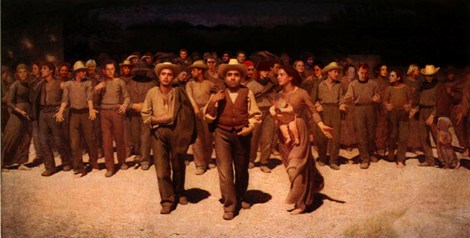
Sommige beelden uit Novecento zouden bijna uit een communistische propagandafilm kunnen komen: close ups van getekende boerenkoppen en wapperende rode vlaggen. Bernardo Bertolucci heeft van zijn rotsvaste geloof in het socialisme dan ook nooit een geheim willen maken. De fascisten zijn in zijn film ondubbelzinnig de slechterikken. In de linkse jaren van polarisatie toen Novecento werd opgenomen (1976) had men met dit zwart-witbeeld dan ook helemaal geen moeite.

Novecento (Bernardo Bertolucci, 1976) is een ruim vijf uur durend epos over het Italiëvan de eerste helft van de 20 eeuw. De film speelt op een groot landgoed. We volgen het leven en de vriendschap van twee jongemannen, Olmo – een onwettig kind van boerenkomaf – en Alfredo – zoon van de grootgrondbezitter. De film toont de opkomst van het fascisme en de reactie daarop van de boeren die uiteindelijk voor het communisme kiezen en proberen de macht op het grootgrondbezit over te nemen. De gebeurtenissen zijn van grote invloed op het lot van de twee hoofdpersonen. Met in de hoofdrollen oa: Robert de Niro, Gérard Depardieu en Donald Sutherland. De film was in de zeventiger jaren een icoon van progressiviteit. Studenten en intellectuelen gingen de film vrijwillig zien, werkende jongeren werd de film voorgeschoteld als verplichte kost tijdens vormingswerkactiviteiten. De film is daarna jarenlang zelden vertoond.
 
Bron: rug.nl

una giornata particolareUna giornata particolare
Afgelopen weekend deed NRC Handelsblad Una giornata particolare (1977) van Ettore Scola aan zijn lezers cadeau. Net als in Novecento vormt het fascisme in deze film een decor. Maar terwijl Bertolucci met Novecento ook een politiek pamflet heeft gemaakt, is Scola’s film een indringend verhaal geworden over twee mensen die de gevangenen zijn van de omstandigheden en troost vinden bij elkaar.

moviemeter.nl | over Bernardo Bertolucci

existentialist of orthodox christen?

Bisschop Hilarion Alfeyev over Dostojewsky
Bisschop Hilarion AlfeyevThe year 2006 marked several dates related to Fyodor Dostoyevsky, such as the 125th anniversary of his death, the 160th birthday of his wife Anna, the 145th anniversary of his novel „The Insulted and Humiliated,„ the 140th anniversary of „Crime and Punishment,„ the 135th anniversary of „The Devils,„ and the 125th anniversary of „The Brothers Karamazov.„ Bishop Hilarion of Vienna and Austria, representative of the Moscow Patriarchate to the European institutions shares his views on Christian contents in the great author’s creative work with Interfax-Religion.
 
What does Dostoyevsky mean to you?
 
He has played a very important part in my religious formation. I read all Dostoyevsky’s novels and diaries by the age of fifteen. His philosophy of life has largely shaped my way of looking at the problems of human life. Dostoyevsky was a giant unsurpassed by any in the Russian literature.
 
As to Dostoyevsky’s literary talent, there were authors who possessed expert skills in writing, like Leo Tolstoy or Vladimir Nabokov. It is known that Dostoyevsky wrote not only because he wanted to write, but also because life itself made him write to earn his living. He was paid for the number of pages, rather than for his ideas and brilliant thoughts. Sometimes he was too verbose and could not express himself laconically. Rather often he was accused of making his characters too soulful and hysterical, violently expressing their emotions.
„If there is no God,
anything is permitted.„
Fjodor DostojewskyHowever, all these shortcomings do not reduce Dostoyevsky’s importance as a greatest writer in the history of humanity. He managed to penetrate into the innermost depths of the human being, to raise the most difficult and important questions about the meaning of life, God’s existence and the relationship between human freedom and God’s justice. After he had served his term of hard labour he remained a deeply believing person and Orthodox Christian till his death. Yet, judging by his works, the question of God’s existence remained open to him. The main story of all his novels, „Crime and Punishment,„ „The Devils,„ or „The Brothers Karamazov,„ is that of whether God exists. The scale of moral values offered to the human beings depends on the answer to this question. That is why one of his characters says: „If there is no God, anything is permitted.„ In other words, if there is no God, there is no absolute scale of moral values, and all the values are relative. I think that Dostoyevsky’s power is in that he showed in all his works that salvation and morality are impossible without God. Only faith in God guarantees moral survival of every human being and all humanity. I had believed in God even before I got to know Dostoyevsky’s works, but the author contributed to my growing in the faith, in Orthodoxy.
 
Bron: orthodoxeurope.org