Maandelijks archief: juni 2007

kaarten van de werkelijkheid

de outsider kunst van Adolf Wölfli (1864 – 1930)

Wat is het verschil tussen het werk van Salvador Dali en de creatieve uitingen van een psychiatrisch patient? Naast de canonisering van de Spaanse surrealist, zijn techniek en zijn marktwaarde, zijn er eigenlijk niet zo veel verschillen. Er is in ieder geval een duidelijke overeenkomst: zowel Dali als een pschychiatrische patient drukken iets uit dat vooral tussen hun oren zit en wat we met een lui oordeel hun waanzin kunnen noemen. Sinds kunst de meest individuele expressie van de meest individuele emotie mag zijn, is er in theorie geen verschil meer tussen officiële kunst en creatieve therapie. Maar de consequentie van deze opvatting strekt nog veel verder: elke uitdrukking kan tot kunst verheven worden, wanneer het individu het hyper-individuele claimt. En dat kan nog verder gaan dan het verheffen van de spreekwoordelijke scheet tot kunst.

Bovenstaande beschouwing is natuurlijk een opmaat voor oeverloos academisch geleuter en daar begin ik liever niet aan. De vraag of iets kunst is, is an Sich eigenlijk niet interessant. Maar soms dringt ze zich op. Dat overkwam mij afgelopen week toen ik geconfronteeerd werd met het werk van Adolf Wölfli, een psychiatrische patient die geldt als de belangrijkste representant van de art brut. Vertegenwoordigers van de art brut, of outsider-kunst, zul je in de canon van de kunst uit de twintigste eeuw niet tegenkomen. Salvador Dali dus wel. Waarom is dat? Die vraag is denk ik niet te beantwoorden. Het blijft geheimzinnig waarom de ene kunstenaar gecanoniseerd wordt en de andere niet.
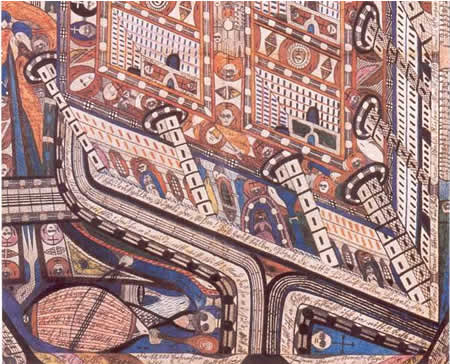
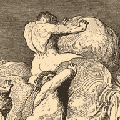
Adolf Wölfli
Adolf Wölfli, detail

Een canon lijkt absoluut, maar is dat allerminst. Smaakopvattingen en marktwerking bepalen of een kunstenaar gecanoniseerd wordt of juist weer uit de canon verdwijnt. Waar het natuurlijk tenslotte om gaat, is dat kunst ons raakt, ontroert of aan het denken zet. En dan mag gelukkig iedereen zijn eigenwijze canon vormen. Zo heb ik besloten Adolf Wölfli in mijn persoonlijke canon op te nemen. Het werk intrigeert me. Dat zal te maken hebben met mijn voorliefde voor cartografie, tijdbalken en systemen. In het werk van Wölfli lijkt het te gaan om een overstijging van de oervraag van de cartografie: waar zijn we? Misschien wel in een reusachtige flipperkast? (zie tekening boven)

Adolf Wölfli Adolf Wölfli had a troubled childhood. He suffered abuse and molestation and was orphaned at the age of 10, thereafter growing up in a series of state-run foster homes. He worked as a farm labourer and briefly joined the army but was later convicted of attempted child molestation for which he served prison time. Sometime after being freed he was arrested for a similar offence and was admitted in 1895 to the Waldau Clinic in Berne, Switzerland, a psychiatric hospital where he spent the rest of his adult life. He was very disturbed and sometimes violent on admission, leading to him being kept in isolation for his early time at hospital, perhaps due to his psychosis which led to intense hallucinations.

At some point after his admission Wölfli began to draw. Unfortunately his earliest drawings have not survived, so it is difficult to know exactly when he began his artistic explorations, although his first surviving works (a series of 50 pencil drawings) are dated from between 1904 and 1906.

Walter Morgenthaler, a doctor at the Waldau Clinic, took a particular interest in Wölfli’s art and his condition, later publishing Ein Geisteskranker als Künstler (A Psychiatric Patient as Artist) in 1921 which first brought Wölfli to the attention of the art world. Morgenthaler’s book was revolutionary in many ways as it was not simply a clinical study but argued that a person with a severe mental illness could be a serious artist and had the ability to make important contributions to the development of art.

Bron: en.wikipedia.org
adolfwolfli.com | Biography

summer of love [ 7 ]

vandaag is het beste live optreden ooit precies 40 jaar geleden:
Big Brother & the Holding Company en Janis Joplin met Ball and Chain
eenmalig, elke keer weer…
Ball and Chain
Sitting down by my window,
Whoa, whoa, looking at the rain.
Whoa, down by my window, baby,
And all around me,
I said suddenly I felt the rain.
Somethin’ grabbed a hold of me, darling,
Honey, it felt to me, honey like, yeah, a ball and chain.
Oh honey, you know what I mean,
It just hurts me.
 
Say, whoa, whoa, whoa, whoa, honey, it can’t be
Whoa, it can’t be, babe,
Said no, no, no, no, no, no, no, no, no, no, hey.
Whoa, baby, it just can’t be
Every time I want to reach out my hand.
No, no, no, no, no, babe, baby, never, no, no,
Never, never, no, no, no.
Here you gone today, but I wanted to love you, darling,
Oh, till the end of time,
Yeah! All right!
 
Love’s got a hold on me baby
Feels like a ball and chain.
Oh, love just draggin’ me down, yeah yeah yeah,
Feels like, honey sometimes it feels honey like a ball, yeah like a ball and a chain
Wonder why when I did the very best I could to love you
You wanted to leave me here, honey in so much pain
Come on, honey, I want you to tell me, please, yeah.
 
Say oh, oh, oh, oh,
Honey this can’t be
No, no no no no no no no no no no no no no no no no no no no no yeah.
Whoa, whoa, whoa
Honey, this can’t be just because I want to want you
Does this mean I have to hide to cry, cry all the time ?
I just wanted to love you, darling,
Every day, oh, whoa, till the, to the very end, to the end of time,
Yeah, no no no no no, hit it!
 
Love’s got a hold on me, baby,
Feels like a ball and chain.
Oh, love’s holdin’ on to me,
Feels to me, oh like a ball and a chain
Honey somethin’ will grab around the knees, grab me in my heart,
Feels to me like a ball and a chain now,
Yeah, alright, yeah!
 
Say oh, oh oh oh,
Honey this can’t be
Tell me please what am I askin’ now,
It can’t be babe
I know it just can’t be, darling, no no.
Whoa whoa whoa, whoa darling don’t you feel me reachin’ out
Tell me, tell me, darling please
Tell, tell, tell me darling please, I’m gonna need it,
I want you to hear me baby
Tell me why, sometimes darling
I said sometimes I feel I got to know why
Sometimes I feel, honey, honey that I need to know why
I said baby when I ask you
I could use a little help sometime
When I say, I say tell me, come on man,
Tell me, tell me, babe,
Honey I never understood, why when I want to work my hands out,
I want to wear my hands out, I try the very best I can, babe
Why you always want to go, honey and let me down baby.
I said why I always wanna go, honey drag me around.
Seems like anything, it could be the telephone company man,
it could be the man I love, I always got something else going, you know what I mean ?
Over on the other side, say, not quite got it right this very minute.
I’m so sorry babe, I said I’m so very sorry babe,
But I never did promise you nothing, right ? I see what you mean.
Come on, man, now come on, that ain’t the name of it,
And that ain’t the end of it, you know what I mean.
Sometimes, it feels just about breaking things, you know what I mean.
Just like, just like a grave, just like a grave to call
Just like a cry to call.
Honey I never understood and I said please
Lord, I swear I never understood and I say please
I want you to help me, fill it up baby,
I want you to help me, I said allow me to hear
Please, please, please, please, please, please, please,
Honey make me understand why love just feels so heavy on me, darling,
Feels so bad on my back, babe,
Feels just like a ball,
Feels like a ball, ball, oh daddy feels like a ball,
And a chain.

Monterey Festival 1967, zondag 18 juni 1967
* Ravi Shankar
* The Blues Project
* Big Brother & The Holding Company
* The Group With No Name
* Buffalo Springfield
* The Who
* Grateful Dead
* The Jimi Hendrix Experience
* Scott McKenzie
* The Mamas & The Papas

groene Victoria [ 2 ]

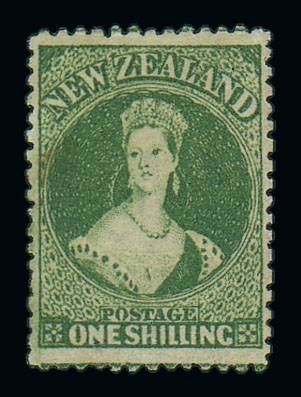
Koningin Victoria op 1 Shilling uit Nieuw Zeeland (1855)

Zaterdag liet ik hier een postzegel zien van Nova Scotia uit 1860 met het portret van Victoria. Maar een andere Britse kolonie was nog eerder met een groene koningin Victoria. In 1855 konden de kolonisten in Nieuw-Zeeland met onderstaande postzegel een brief naar het moederland sturen.

postzegel Nieuw Zeeland 1855
Victoria uit 1855 met het ‘Chalon’ portret

Het portret is een gravure naar een schilderij van Alfred Edward Chalon dat hij in 1838 van de 19-jarige Victoria had gemaakt. Dit portret werd ook voor frankeerzegels van andere overzeese gebieden van het Brits imperium gebruikt, zoals Queensland, Tasmania, Natal en de Bahamas.

The Chalon portrait of Queen Victoria was by Alfred Edward Chalon, R.A. (1780-1860) painted in 1838, the year after she acceded to the throne. Chalon sketched the Queen on her first visit to the House of Lords in 1837 and derived the painting from that. In fact he produced three different paintings and it was much copied by other painters for official portraits. These, engravings and mezzotint copies of the portrait made it a well known image in early Victorian times.
 
Bron: 100megsfree3.com
postzegel Canada 1851
Canada 1851

De oudste zegel met het ‘Chalon’ portret die ik op het web kon vinden, is er een van Canada uit 1851. Nederland had op dat moment nog steeds geen postzegels, maar zou een jaar later pas beginnen met emissies. Daarmee was ons land vrij laat met de invoering van de frankeerzegel. Engeland (1840) , de Verenigde Staten (1847), Denemarken (1848), Frankrijk (1848), België(1849) en Beieren (1849) waren ons o.a. al vooraf gegaan.

postzegels tussen 1840 – 1850