Maandelijks archief: augustus 2006

virtuele reis door de hel [7]

deze maand daal ik met Dante en Vergilius af in de hel
de zesde kring: de ketters

Phlegyas zet Dante en Vergilius de Styx over . Nadat een engel de poort geopend heeft, komen ze in de stad van Dis (een van de Latijnse namen van de god Hades), waar de geweldplegers gestraft worden. Het eerste deel van Dis, de zesde kring van de hel, is een grafveld met brandende open graven, waarin de ketters liggen, o.a. Epicurus.
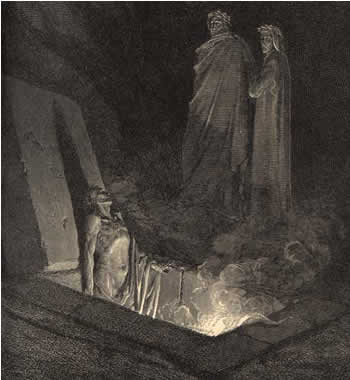
ketters
Zodra ik bij deze tombe stond, keek hij me wat laatdunkend aan en vroeg: “Wie waren uwe vaderen?”
Dante opts for the most generic conception of heresy–the denial of the soul’s immortality (Inf. 10.15)–perhaps in deference to spiritual and philosophical positions of specific characters he wishes to feature here, or perhaps for the opportunity to present an especially effective form of contrapasso: heretical souls eternally tormented in fiery tombs. More commonly, heresy in the Middle Ages was a product of acrimonious disputes over Christian doctrine, in particular the theologically correct ways of understanding the Trinity and Christ. Crusades were waged against “heretical sects,” and individuals accused of other crimes or sins–e.g., witchcraft, usury, sodomy–were frequently labeled heretics as well.
 
Heresy, according to a theological argument based on the dividing of Jesus’ tunic by Roman soldiers (Matthew 27:35), was traditionally viewed as an act of division, a symbolic laceration in the community of “true” believers. This may help explain why divisive, partisan politics is such a prominent theme in Dante’s encounter with Farinata.
 
Bron: danteworlds.laits.utexas.edu
Dante Online | illustraties Doré | Dante Inferno

virtuele reis door de hel [6]

deze maand daal ik met Dante en Vergilius af in de hel
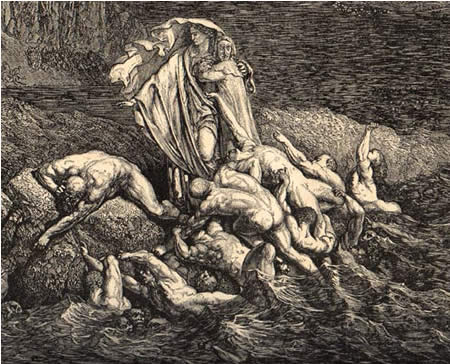
de vijfde kring: de wraakzuchtigen

De vijfde kring bevat de moerassige Styx, waarin de agressievelingen elkaar tot in eeuwigheid bevechten. De wrokkigen liggen onder water.

wraakzuchtigen
Like the fourth circle of hell, the fifth circle–presented in Inferno 7 and 8–contains two related groups of sinners. But whereas avarice and prodigality are two distinct sins based on the same principle (an immoderate attitude toward material wealth), wrath and sullenness are basically two forms of a single sin: anger that is expressed (wrath) and anger that is repressed (sullenness). This idea that anger takes various forms is common in ancient and medieval thought. Note how the two groups suffer different punishments appropriate to their type of anger–the wrathful ruthlessly attacking one another and the sullen stewing below the surface of the muddy swamp (Inf. 7.109-26)–even though they are all confined to Styx.
 
Bron: danteworlds.laits.utexas.edu

Dante Online | illustraties Doré | Dante’s Inferno

virtuele reis door de hel [5]

deze maand daal ik met Dante en Vergilius af in de hel
de vierde kring: de hebzuchtigen

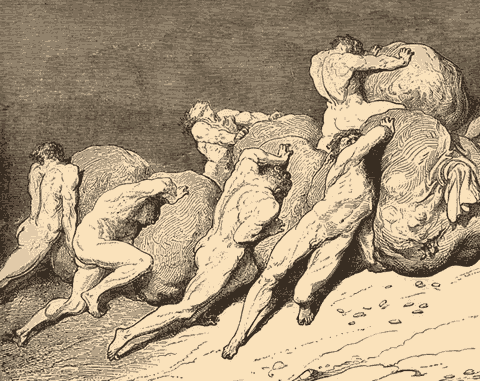
In de vierde kring duwen de hebzuchtigen én de verkwisters zware lasten zinloos heen en weer.

hebzuchtigen
Avarice–greed, lust for material gain–is one of the iniquities that most incurs Dante’s scornful wrath. Consistent with the biblical saying that avarice is “the root of all evils” (1 Timothy 6:10), medieval Christian thought viewed the sin as most offensive to the spirit of love; Dante goes even further in blaming avarice for ethical and political corruption in his society. Ciacco identifies avarice–along with pride and envy–as one of the primary vices enflaming Florentine hearts (Inf. 6.74-5), and the poet consistently condemns greed and its effects throughout the Divine Comedy. Dante accordingly shows no mercy–unlike his attitude toward Francesca (lust) and Ciacco (gluttony)–in his selection of avarice as the capital sin punished in the fourth circle of hell (Inferno 7). He viciously presents the sin as a common vice of monks and church leaders (including cardinals and popes), and he further degrades the sinners by making them so physically squalid that they are unrecognizable to the travelers (Inf. 7.49-54). By defining the sin as “spending without measure” (7.42), Dante for the first time applies the classical principle of moderation (or the “golden mean”) to criticize excessive desire for a neutral object in both one direction (“closed fists”: avarice) and the other (spending too freely: prodigality). Fittingly, these two groups punish and insult one another in the afterlife.
 
Bron: danteworlds.laits.utexas.edu

Dante Online | illustraties Doré | Dante’s Inferno