Maandelijks archief: mei 2007

terribly happy

gezien: Rebecca (1940) van Alfred Hitchcock op BBC 2
met Laurence Olivier en Joan Fontaine

Vijf weken geleden zag ik Hitchcock’s klassieker Vertigo (1957) en gisterenavond keek ik naar Rebecca (1940). De twee films hebben een duidelijke overeenkomst: een mooie jonge vrouw wordt beheerst door de geest van een overleden vrouw en raakt steeds meer verstrikt in een nachtmerrie. Terwijl Kim Novak in Vertigo in het begin het boze spel meespeelt , is Joan Fontaine vanaf het begin de blanke onschuld zelve en dus het volmaakte slachtoffer.
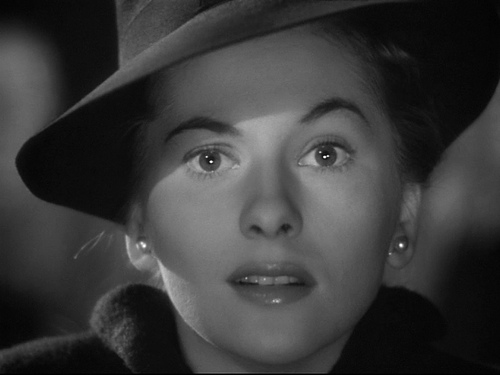
Joan Fontaine
een waanzinnig mooie Joan Fontaine
speelt de hoofdrol in Rebecca
RebeccaHet personage dat Joan Fontaine speelt is niet alleen mooi, maar ook kwetsbaar, een fatale combinatie, zodat ik meteen voor haar viel. In Rebecca speelt zij een ‘gewoon meisje’ dat trouwt met een door de herinneringen aan de dood van zijn eerste vrouw Rebecca achtervolgde rijkaard Laurence Olivier, die een spookachtig Citizen Kane-achtig landgoed bewoont. Wat volgt is een boosaardig sprookje waarin Hitchcock het fileermes zet in het huwelijk van de twee. Hitchcock mag dan de titel ‘master of suspense’ dragen, in Rebecca gaat het niet om spanning, maar om de door herinneringen gekwelde menselijke psyche. De scène halverwege de film waarin het getrouwde stel de kwaliteit van hun huwelijk bespreekt, is groots. “Our marriage is a succes, isn’t it? A great succes”, roept de vrouw bezwerend uit, om te vervolgen met: “We’re happy, aren’t we? Terribly happy”. Wie houdt het vervolgens droog bij het ineenkrimpen van de vrouw onder de mokerslag die de getormenteerde man op haar laat neerdalen: “Happiness is something I know nothing about”.
 
Bron: filmkrant.nl

bespreking van Rebecca [ digg.be ]

en nooit weerom [ 2 ]

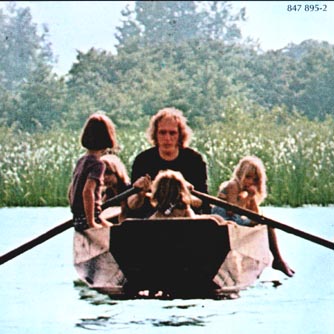
Vandaag blijf ik nog steeds luisteren naar En Nooit Weerom (1974)
van Herman van Veen met teksten van Rob Chrispijn

verzameling

Een straaljager trekt een streep door de hemel
Een merel slaat alarm
Het grasveld vergeelt onder mijn handen
De mollen hebben het warm

De man op de bank in de gloeiende zon
Praat over Zwitserland
Waar de wereld haar geld bewaart
Hij had vroeger ook iets gespaard maar wat
Is ie vergeten
Maar goed ook zegt ie, gek
Hoe alles op den duur
In een verzameling ontaard

En hij kan het weten
Hij had dozen vol bladeren
Een hele herfst in een kast
Hij zei: in mijn strijd tegen de tijd
Vormt alles wat valt een houvast

En het is voor zijn bestwil
Dat hij hier zit
Staart en eet en slaapt
Maar ik weet wat ze onder helpen verstaan
Ze hebben het met de kat gedaan
Die ligt nu lui en vadsig voor de haard

en nooit weerom

De schemering sluipt
Over het grasveld
De nacht staat op een kier
De man op de bank wordt langzaam doorzichtig
Ik was liever bij jou
Maar ik ben hier

Bron: waltertje.com

Discografie Herman van Veen

plein air

pleinair schilders in de Verenigde Staten
Painting from life is a pursuit unlike any other painting technique. It challenges artists to concentrate every sensory nerve on the information in front them. They absorb it all, from sight to sound, from temperature to atmosphere, and then channel those feelings from head to hand, re-creating the vision in paints on paper or canvas.
 
Scott BurdickThe roots of painting from life are found in 19th-century Europe. Englishman John Constable believed the artist should forget about formulas and trust his own vision in finding truth in nature. To find that truth, he made sketches outdoors, then elaborated on them in the studio.
 
Around the same time in France, in a small village outside Paris called Barbizon, a group of artists focused their attentions on peasant life and the natural world surrounding it. Like Constable, Francois Millet and Gustave Courbet challenged conventions of the day, choosing everyday subjects rather than the traditional cliches and presenting them in natural settings, the information for which came from sketches made in the field.
We paint from life in order to learn how to see. If you can paint light, you can paint everything under the sun.

Frank LaLumia

These realists, as they came to be called, laid the groundwork for the mid-19th century revolution in France that took painting from life to its logical conclusion. Lead by Edouard Manet, Claude Monet, Edouard Degas, Auguste Renoir, et. al. the impressionists espoused the belief that you should trust your eyes. Using newly developed theories of how the eye physically registers color, they maintained that what you saw in nature was not form, but rather light on form. And light could be conveyed by color. To prove their theories, they took their paint tubes and easels outdoors, where they re-created the world as colors which suggested light. Rebuffed at first for what appeared to be unfinished paintings, the impressionist vision soon became a standard for truthfully conveying the outdoor experience.
 
Matt SmithPainting en plein air (in the open air) would forever change how we see the world. Artists in the United States were attracted to the concept, and many, like Californian Guy Rose, traveled to France to study with Monet. Suddenly, places with remarkable light were of particular interest to painters, including the both the East and West Coasts, and the American Southwest, where painting colonies formed. The goal of teachers and students alike was to capture the light and colors peculiar to the place.
 
Today, painting from life is a pursuit that continues to challenge the finest artists in the world, and no group is better known for upholding that credo than the Plein-Air Painters of America.
 
Bron: www.p-a-p-a.com

Plein Air Painters of America